English
 عربى
عربى
 Español
When designing or upgrading a fine bubble aeration system, one of the most common questions is whether to use a 9-inch or 12-inch disc diffuser. The larger diffuser can handle more airflow and cover more tank area, but this does not automatically mean that it provides better oxygen transfer efficiency or lower energy consumption in every installation.
The correct choice depends on total airflow demand, tank dimensions, diffuser density, operating range, piping arrangement, oxygen demand distribution and maintenance requirements. For some plants, using fewer 12-inch diffusers simplifies the system. In others, a larger number of 9-inch diffusers provides better floor coverage and more flexible airflow distribution.
This guide compares the two sizes from an engineering and purchasing perspective and explains how to select the appropriate diffuser for a wastewater aeration project.
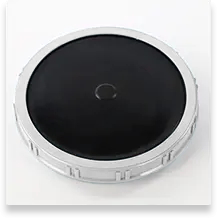
Quick Answer: 9 Inch vs 12 Inch Disc Diffuser
The practical difference is airflow capacity, not simply oxygen efficiency.
A 9-inch disc diffuser is generally suitable when the design requires more individual aeration points, tighter diffuser spacing, moderate airflow per unit or greater flexibility in distributing oxygen across the basin.
A 12-inch disc diffuser has a larger membrane surface and can operate at a higher airflow per unit. It may therefore reduce the total number of diffusers, saddles, fittings and installation points required in a large aeration system.
However, diffuser diameter alone should never determine the final design. Total oxygen demand and airflow should be calculated first, followed by a check of diffuser quantity, basin coverage, operating airflow and pressure loss.
9 Inch vs 12 Inch Disc Diffuser Specifications
The following comparison uses Nihao Water's DD270 and DD350 fine bubble disc diffuser specifications.
| Parameter | 9 Inch Disc Diffuser - DD270 | 12 Inch Disc Diffuser - DD350 |
| Bubble Type | Fine Bubble | Fine Bubble |
| Typical Bubble Size | 1.0-2.0 mm | 1.0-2.0 mm |
| Design Airflow | 3.0-4.0 m³/h | 5.0-6.0 m³/h |
| Airflow Range | 1.5-8.0 m³/h | 2-12 m³/h |
| Typical Service Area | 0.25-1.0 m² | 0.4-1.5 m² |
| Standard Oxygen Transfer Efficiency at 6 m Submergence | ≥38% | ≥38% |
| Number of Perforations | 6,600 | 11,440 |
| Membrane Thickness | 2 ± 0.1 mm | 2 ± 0.1 mm |
| Standard Connector | 3/4" NPT male thread | 3/4" NPT male thread |
Airflow Capacity Is the Main Difference
The most obvious engineering difference between the two sizes is the amount of air that each diffuser can distribute while remaining within its preferred operating range.
For the Nihao DD270, the design airflow is approximately 3-4 m³/h per diffuser. For the DD350, the recommended design range rises to approximately 5-6 m³/h per diffuser.
This means that a plant requiring a high total airflow can potentially use fewer 12-inch diffusers.
That reduction can influence:
- total diffuser quantity;
- number of pipe connections and saddles;
- length and arrangement of laterals;
- installation labor;
- future diffuser replacement work; and
- capital cost of the aeration grid.
But fewer diffusers are not always preferable. An aeration system must still distribute air across the required floor area and match the biological oxygen demand throughout the basin.
Does a 12 Inch Disc Diffuser Provide Better Oxygen Transfer?
Not necessarily.
This is one of the most important distinctions for engineers and buyers to understand.
A larger diffuser provides more membrane area and usually allows a greater airflow per unit. It does not automatically produce smaller bubbles or a higher Standard Oxygen Transfer Efficiency.
In the Nihao DD270 and DD350 specifications, both diffuser sizes generate approximately 1-2 mm fine bubbles, and both are rated at a Standard Oxygen Transfer Efficiency of at least 38% at 6 m submergence under the specified test conditions.
Actual oxygen transfer in a wastewater tank is affected by many additional factors, including:
- airflow per diffuser;
- water depth;
- diffuser density;
- floor coverage;
- wastewater characteristics;
- alpha factor;
- mixed liquor solids;
- surfactants and industrial contaminants;
- membrane fouling;
- basin geometry; and
- distribution of oxygen demand.
For this reason, comparing diffuser diameter alone is not a reliable method for predicting aeration efficiency.
Diffuser Quantity and Floor Coverage
Large diffusers can reduce diffuser count, but the resulting layout still needs to provide adequate aeration coverage.
Consider a rectangular activated sludge tank. Installing 100 large diffusers instead of 160 smaller diffusers may reduce equipment quantity, but the designer must check whether the wider spacing still provides suitable mixing and oxygen distribution throughout the basin.
This becomes particularly important in plug-flow systems, where oxygen demand may be substantially higher near the influent end than near the outlet.
Why a Higher Diffuser Density Can Be Useful
More diffuser units provide additional air-release points across the tank floor. This can be useful when the design requires:
- high floor coverage;
- tapered aeration;
- multiple independently controlled aeration zones;
- more uniform mixing;
- better response to changing process loads; or
- retrofit into an existing lateral pipe arrangement.
This is one reason a 9-inch diffuser may remain the better solution even when a 12-inch model can technically handle the required total airflow.
Example: 550 m³/h Aeration System
A simple airflow comparison demonstrates the difference.
Assume an aeration tank requires a total process airflow of:
Option 1: 9 Inch DD270
If a preliminary design airflow of 3.5 m³/h per diffuser is used:
Number of diffusers ≈ 157
The designer might initially consider approximately 160 units, depending on grid geometry and zoning.
Option 2: 12 Inch DD350
If a preliminary design airflow of 5.5 m³/h per diffuser is used:
Number of diffusers = 100
In this simplified example, using 12-inch diffusers reduces the number of aeration points from approximately 160 to 100.
Headloss, Blower Pressure and Energy Consumption
Another common mistake is assuming that installing fewer large diffusers will automatically reduce blower energy consumption.
Blower pressure is determined by the resistance of the entire aeration system, not simply diffuser quantity.
Water depth usually represents the largest part of the static pressure requirement. However, membrane resistance and dynamic wet pressure also matter, particularly when operating at higher airflow rates or when diffusers become fouled.
Increasing the airflow through an individual diffuser can increase membrane pressure loss. At the same time, operating a membrane significantly outside its preferred range may reduce oxygen-transfer performance.
Therefore, the correct comparison is not:
"Which diffuser is larger?"
It is:
"Which diffuser arrangement can satisfy the required oxygen transfer at an appropriate airflow and pressure?"
When Should You Choose a 9 Inch Disc Diffuser?
Smaller or Medium Aeration Tanks
A 9-inch diffuser is often easier to distribute across tanks where the total airflow is moderate and a large 12-inch unit would leave excessive spacing between aeration points.
Retrofit Projects
Existing aeration grids may already have saddles and laterals designed around smaller diffuser spacing. Maintaining a 9-inch configuration may reduce piping modifications.
Tapered Aeration
More individual diffuser positions can make it easier to concentrate aeration in high-demand zones and reduce it in lower-demand sections of a plug-flow tank.
Low to Moderate Airflow
If the total air requirement is relatively small, a 9-inch model can keep individual diffusers operating closer to their preferred design airflow.
A 9-inch diffuser is therefore a strong choice when distribution flexibility and diffuser density matter more than minimizing the number of diffuser units.
When Should You Choose a 12 Inch Disc Diffuser?
Large Aeration Basins
Large municipal or industrial tanks with substantial airflow requirements can benefit from the higher air-handling capacity of a 12-inch diffuser.
High Total Airflow
Because each diffuser can handle more air, the total number of units required for a large system can be reduced.
Reducing Installation Points
Fewer diffusers can mean fewer saddles, connections and membrane assemblies, potentially simplifying installation and future replacement.
Full-Floor Aeration with Suitable Spacing
Where basin geometry permits sufficient coverage using larger units, 12-inch diffusers can provide an efficient and relatively simple grid configuration.
A 12-inch diffuser is therefore particularly attractive when high airflow capacity and lower equipment count can be achieved without sacrificing floor coverage or process flexibility.
Minimum and Maximum Airflow Matter
Diffuser sizing should not be based only on peak airflow.
Wastewater treatment plants often operate across a wide range of process conditions. Air demand may fall substantially at night, during low production periods or under seasonal low loading.
For this reason, engineers should check both:
- maximum airflow per diffuser during peak oxygen demand; and
- minimum airflow per diffuser during low-load operation.
If too many large diffusers are installed in a system with very low minimum airflow, each diffuser may receive insufficient air during turndown.
Conversely, using too few small diffusers can force each membrane to operate at excessive airflow during peak conditions.
The best design keeps the diffuser grid within a practical airflow range throughout normal plant operation.
Membrane Material May Matter More Than Disc Diameter
Once the appropriate diffuser size has been identified, membrane selection becomes another major design consideration.
Fine bubble disc diffusers are commonly available with EPDM, PTFE-coated EPDM, silicone and other specialized membrane materials.
The preferred material depends on the wastewater.
| Membrane Type | Typical Consideration | Common Applications |
| EPDM | General-purpose option with a good balance of flexibility, performance and cost | Municipal wastewater and many industrial applications |
| PTFE-Coated EPDM | Improved resistance to some forms of fouling, scaling and aggressive wastewater conditions | Industrial wastewater, higher fouling risk |
| Silicone | Useful where chemical resistance and membrane flexibility are important | Selected industrial wastewater applications |
A correctly sized diffuser with the wrong membrane material can still experience premature fouling or performance degradation. Size and material should therefore be selected together.
9 Inch vs 12 Inch: Selection Summary
| Design Condition | 9 Inch | 12 Inch |
| Small or medium basin | Often preferred | Possible, depending on layout |
| Very high total airflow | Requires more units | Often advantageous |
| Need fewer installation points | Less advantageous | Preferred |
| Need dense floor coverage | Often advantageous | Requires layout check |
| Tapered aeration | Highly flexible | Possible with correct zoning |
| Retrofit existing dense grid | Often easier | May require piping changes |
| High airflow per unit | Moderate | Higher |
| Oxygen transfer efficiency | Depends on complete system design | Depends on complete system design |
Information Needed Before Selecting a Disc Diffuser
A supplier cannot reliably recommend 9-inch or 12-inch diffusers based only on tank volume. For an engineering selection, provide as much operating information as possible.
- wastewater type or industry;
- daily treatment capacity;
- aeration tank length, width and water depth;
- number of aeration tanks;
- influent and target BOD or COD;
- ammonia concentration and nitrification requirement;
- MLSS if available;
- required DO concentration;
- calculated AOR, SOR or total airflow;
- existing blower capacity;
- minimum and maximum operating airflow;
- existing lateral pipe dimensions;
- available diffuser spacing;
- wastewater temperature; and
- known fouling, scaling or chemical compatibility concerns.
With these data, the diffuser supplier can evaluate not only disc diameter but also the required quantity, grid arrangement, membrane type, connector configuration and approximate blower requirements.
Final Recommendation
There is no universal rule that a 12-inch disc diffuser is better than a 9-inch diffuser simply because it is larger.
The 9-inch diffuser is often the more flexible option for systems requiring closer spacing, more aeration points, moderate airflow and detailed control of oxygen distribution.
The 12-inch diffuser is particularly useful in large systems where higher airflow per diffuser can reduce the number of units and simplify the aeration grid.
The correct decision should be based on total oxygen demand, required airflow, basin geometry, diffuser density, operating range, headloss and lifecycle maintenance rather than nominal diffuser diameter alone.
For a new wastewater treatment plant or aeration retrofit, the best approach is to calculate the oxygen and airflow requirements first and then compare several diffuser layouts before finalizing the equipment quantity.
Need Help Selecting 9 Inch or 12 Inch Disc Diffusers?
Nihao Water supplies fine bubble disc diffusers for municipal and industrial wastewater treatment systems, including different diffuser sizes and membrane options.
Send us your aeration tank dimensions, wastewater flow, water depth and required airflow. Our team can help evaluate diffuser size, preliminary quantity, grid arrangement and membrane selection for your project.