


 English
 عربى
عربى
 Español


×
Password
Get password
Enter password to download relevant content.
Submit
 +86-15267462807
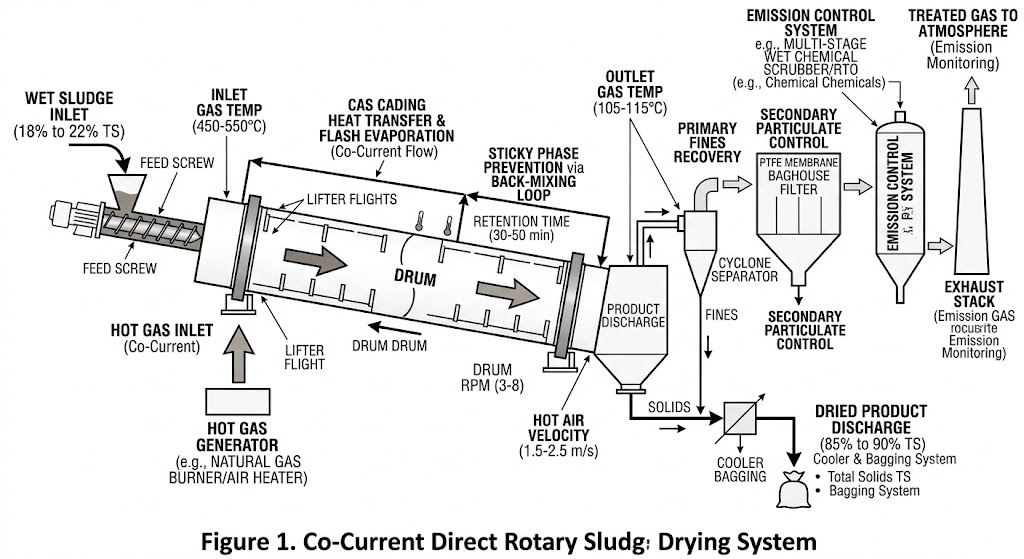
Rotary drying stands as a foundational thermal dewatering technology for industrial and municipal wastewater residuals. The core mechanism relies on a rotating cylindrical drum, slightly inclined to the horizontal, which cascades wet sludge through a stream of heated gas. In direct (convection) rotary dryers, the hot flue gas or heated air comes into direct contact with the sludge, maximizing heat and mass transfer rates. In indirect (conduction) configurations, the heating medium (typically steam or hot thermal oil) flows through a jacket or internal tubes, transferring thermal energy through the metal walls to minimize exhaust gas volume and odor containment challenges.
The internal mechanics are heavily governed by the lifter or flight profile. As the drum rotates, these flights lift the sludge and shower it down through the gas stream, creating a continuous curtain of material that optimizes the volumetric heat transfer coefficient. Gas flow configuration dictates the thermal gradient: co-current (parallel) flow introduces the hottest gas to the wettest sludge, preventing product scorching and volatile organic compound (VOC) flashing, whereas counter-current flow brings the driest product into contact with the hottest gas, achieving ultra-low residual moisture but requiring stringent temperature controls.
Operational control requires strict adherence to quantitative parameters. For typical municipal sludge with an initial feed solids content of 18% to 22% Total Solids (TS) targeting a final product of 85% to 90% TS, direct dryer inlet gas temperatures typically range from 450 to 550 degrees Celsius, with corresponding outlet temperatures maintained strictly between 105 and 115 degrees Celsius to prevent condensation. Retention time within the drum ranges from 30 to 50 minutes, depending on drum RPM (typically 3 to 8 RPM) and flight geometry. The optimal hot air velocity is balanced between 1.5 and 2.5 meters per second; velocities below this range reduce moisture carrying capacity, while excessive velocities cause premature entrainment of fine particles, overloading downstream cyclones.
Moisture monitoring utilizes online high-frequency microwave or near-infrared (NIR) sensors placed at the discharge chute for real-time feedback, supplemented by offline gravimetric oven-drying verification (Standard Method 2540G). A critical, frequently overlooked control variable is feed consistency. Sudden drops in feed solids content increase the thermal load instantly, causing a rapid decline in exhaust gas temperature; if the exhaust temperature drops below the dew point (typically around 80 to 85 degrees Celsius for highly humid streams), localized condensation occurs, leading to severe sludge sticking, scaling, and erratic VOC release patterns.
The sequential breakdown of the rotary drying mechanism operates through the following distinct physical phases:
Optimizing the economics of a rotary drying system requires rigorous attention to pre-dewatering stages. Feeding raw liquid sludge directly into a thermal dryer is thermodynamically prohibitive. Economical operation demands pre-dewatering to a minimum of 18% to 25% TS. Common mechanical dewatering technologies exhibit distinct performance and polymer dosing ranges: belt filter presses typically yield 18% to 22% TS with a cationic polymer dose of 6 to 10 kilograms per dry ton; screw presses deliver 20% to 24% TS at 8 to 12 kilograms per ton; and high-speed solid-bowl centrifuges achieve 22% to 28% TS but require higher polymer dosages ranging from 10 to 15 kilograms per dry ton. Residual polyacrylamide (PAM) from these steps can exacerbate sludge stickiness during the subsequent thermal transition.
To accurately size a rotary dryer, engineers must execute a strict mass balance. Consider a municipal facility processing 50 wet tons per day of dewatered sludge cake at an initial solids content of 18% TS, with a target final dryness of 85% TS. The total dry mass processed per day is calculated as: 50 wet tons multiplied by 0.18, which equals 9 dry tons per day. The final product mass is calculated as: 9 dry tons divided by 0.85, which equals 10.59 tons of dried product per day. Therefore, the hourly water evaporation rate (W) required over a 24-hour operating window is: (50 minus 10.59) divided by 24, which equals 1.642 tons of water evaporated per hour, or approximately 1642 kilograms of water per hour.
Assuming a conservative volumetric evaporation water rate of 35 kilograms of water per cubic meter-hour for direct rotary dryers, the required active drum volume (V) is: 1642 divided by 35, which equals 46.9 cubic meters. Choosing a standard diameter-to-length ratio of 1-to-5, a drum diameter (D) of 2.2 meters and an active length (L) of 11.0 meters provides a total volume of 41.8 cubic meters; adjusting the length slightly to 12.5 meters yields the required 47.5 cubic meters, establishing a robust sizing envelope. The theoretical residence time (t) can be cross-verified using the empirical relation: t = (0.23 * L) / (D * RPM * S), where S is the drum slope (typically 3% to 5%). For a 12.5-meter drum at 5 RPM with a 4% slope, the retention time perfectly matches the required 40-minute thermal profile.
Managing seasonal sludge fluctuations requires an automated back-mixing (or back-pass) system. When wet cake falls into the 40% to 60% TS range, it enters the notorious "sticky phase" where the material behaves as a highly viscous paste, causing catastrophic flight blinding and drum plugging. To circumvent this, a portion of the finished 85% TS dry granules is mechanically recycled and blended with the incoming 18% TS wet cake in a dual-shaft paddle mixer before entering the dryer feed chute. This immediately elevates the blended feed solids above 62% TS, completely bypassing the sticky phase and ensuring a free-flowing, granular feed that eliminates blockages.
Thermal sludge drying is an energy-intensive utility, demanding rigorous quantification of the net energy balance. The baseline energy consumption for evaporating water in a direct rotary dryer ranges from 2800 to 3200 Kilojoules per kilogram of water evaporated, which translates roughly to 775 to 890 Kilowatt-hours of thermal energy per ton of water removed. Electrical power consumption for auxiliary equipment—including drum drives, feed screws, induced draft fans, and recirculation pumps—adds an extra 30 to 50 Kilowatt-hours per wet ton processed. The exact breakdown of the thermal energy balance comprises: the latent heat of vaporization (fixed at approximately 2260 Kilojoules per kilogram), the sensible heat required to raise the sludge matrix and water from ambient to evaporation temperature (typically 150 to 200 Kilojoules per kilogram), and system radiation and exhaust gas stack losses (ranging from 400 to 700 Kilojoules per kilogram).
The selection of the primary heat source fundamentally shapes operational expenditures (OPEX) and carbon intensity, as detailed below:
| Heat Source Type | Thermal Efficiency Range | Relative Operating Cost | Carbon Footprint Impact |
|---|---|---|---|
| Natural Gas (Direct-Fired) | 80% - 85% | Medium (Market Dependent) | Moderate (Fossil Fuel Baselines) |
| Saturated Steam (Indirect) | 75% - 82% | Low (If Co-generated) | Variable (Depends on Boiler Fuel) |
| Flue Gas Waste Heat | 60% - 70% | Near Zero | Lowest (Negligible Net Emissions) |
| Biomass Gasification | 70% - 78% | Low to Medium | Carbon Neutral Potential |
| Electrical Heat Pumps | 200% - 300% (COP equivalent) | High (Regional Electric Rates) | Low (If tied to Clean Grid) |
Air emission control and strict odor mitigation are mandatory to ensure compliance with U.S. Federal EPA Clean Air Act standards and state-level Title V operating permits. The exhaust stream from a rotary sludge dryer contains high concentrations of moisture, fine particulates, hydrogen sulfide, ammonia, and volatile organic compounds. Particulate control is achieved via a two-stage system: a primary high-efficiency cyclone that recovers 95% to 98% of the dried biosolid fines, followed by a pulse-jet baghouse equipped with polytetrafluoroethylene (PTFE) membrane filters rated for high-temperature, humid environments.
For gaseous pollutants and odor compliance, engineering selection depends on regional regulations. Thermal Oxidizers (TO) or Regenerative Thermal Oxidizers (RTO) are deployed when destruction of VOCs and absolute odor elimination are legally mandated; they operate at 815 to 870 degrees Celsius with a 0.5 to 1.0 second residence time, achieving 99% destruction efficiency but incurring substantial fuel penalties. Where fuel costs are prohibitive and chemical restrictions allow, multi-stage wet chemical scrubbers utilizing sodium hypochlorite, sodium hydroxide, and sulfuric acid are deployed to neutralize acid gases and odorants, frequently followed by an engineered bio-filter bed with wood chip media to bio-degrade residual trace organic compounds before atmospheric discharge via an elevated stack.
The processing of sludge through a rotary dryer transforms a hazardous liquid waste into a valuable, stable commodity. Under U.S. EPA Part 503 regulations, maintaining a product temperature-time relationship where sludge solids are subjected to temperatures exceeding 70 degrees Celsius for a continuous period of at least 30 minutes, combined with achieving a final dryness greater than 90% TS, classifies the material as Class A Biosolids. Class A status certifies that pathogen densities are reduced below detectable limits, allowing the material to be marketed as an unrestricted fertilizer or soil amendment for agricultural use, turf farming, and land reclamation, thereby completely eliminating landfill tipping fees. Alternatively, due to the high organic content, dried biosolids possess a lower heating value of 12000 to 16000 Kilojoules per dry kilogram, making them an excellent supplementary fuel for cement kilns or coal-fired power plants.
Upon exiting the rotary drum, the dried granules are at a temperature of 85 to 105 degrees Celsius. Immediate storage at this temperature introduces an extreme risk of spontaneous combustion, driven by localized biological and chemical oxidation. Consequently, the product must immediately enter an indirect rotary or jacketed screw cooler to reduce the core temperature below 40 degrees Celsius before conveying to pelletizing stations or storage silos. Furthermore, the handling of dry biosolid dust is strictly governed by NFPA 652 (Standard on the Fundamentals of Combustible Dust) and NFPA 855. All enclosed conveyors, storage silos, and bagging stations must feature explosion relief venting panels, spark detection systems, and nitrogen or recirculated low-oxygen gas inerting loops to prevent dust explosions.
Economic evaluation requires a clear Capital Expenditure (CAPEX) and Operational Expenditure (OPEX) matrix. For a standard 50 wet tons per day municipal installation, CAPEX ranges from 3.5 million to 5.5 million US dollars, encompassing the dryer drum, pre-dewatering upgrades, back-mixing loops, air treatment trains, and automated control systems. OPEX is dominated by thermal energy costs (typically 45% to 55% of total operating expenses), followed by electrical energy (15% to 20%), maintenance wear components (15%), and polymer consumables. Mechanical maintenance strategies must prioritize high-wear components: main drum graphite or carbon mechanical seals must be inspected quarterly and replaced every 12000 to 18000 operating hours; inlet internal lifters and wear liners require hard-facing welding or replacement every 24000 hours due to sludge abrasiveness; and main trunnion bearings require continuous automated lubrication to prevent premature catastrophic fatigue.
Before full-scale capital deployment, engineering teams should execute a structured pilot testing program. A rigorous 5-to-10 day pilot protocol using a mobile 200-kilogram-per-hour rotary dryer is essential to map the specific sludge characteristics. The comprehensive pre-commissioning sampling and testing matrix should follow the exact parameters outlined below:
| Testing Parameter | Analytical Method Reference | Engineering Purpose / Actionable Design Metric |
|---|---|---|
| Total Solids & Volatile Solids | EPA Method 1684 / SM 2540G | Establishes exact mass balance and calculates net volatile organic loading. |
| Sludge Sticky Phase Zone | Rheological Torque Profile | Identifies the precise moisture boundaries to program the back-mixing recycle ratio. |
| Fecal Coliform / Salmonella | EPA Part 503 Rule Compliance | Verifies pathogen destruction efficiency to guarantee Class A biosolid certification. |
| Exhaust VOC & Speciated Odor | EPA Method 25A / ASTM E679 | Sizes the thermal oxidizer or wet chemical scrubber system for local air permits. |
| Ash Fusion Temperature | ASTM D1857 | Determines slagging potential if the dried biosolid is utilized as a fuel source. |
Deploying an optimized thermal drying system requires precise balancing of thermodynamics, mechanical engineering, and environmental compliance. Standard off-the-shelf equipment rarely delivers the efficiency required to handle complex municipal and industrial sludge matrices safely. To assist your engineering team in navigating the initial design phases, our technical department provides a complimentary, cloud-based Sludge Drying Energy & Sizing Estimator. This engineering tool utilizes your specific operational inputs to generate a preliminary mass balance, baseline drum dimensions, and estimated utility requirements within minutes.
To secure a tailored capital asset profile or to schedule a comprehensive pilot-scale assessment at your facility, contact our application engineering group today. When initiating your consultation, please ensure your project team has gathered the following primary input criteria to accelerate the engineering evaluation:
Schedule a technical conference call with our senior process engineers to obtain a comprehensive CAPEX, OPEX, and localized return-on-investment (ROI) analysis customized to your facility’s unique operational parameters.



86-15267462807


86-15267462807
