


 English
 عربى
عربى
 Español


×
Password
Get password
Enter password to download relevant content.
Submit
 +86-15267462807
Aeration technology is the engineered process of transferring oxygen into wastewater to support biological treatment and maintain process stability.
In activated sludge systems, aeration provides dissolved oxygen (DO) for microorganisms that remove BOD, COD, and ammonia. It also ensures complete mixing, preventing sludge settling and anaerobic zones.
In most municipal and industrial treatment plants, aeration consumes 40–60% of total energy use, making it the single largest operational cost center.
Aeration performs three simultaneous functions:
• Oxygen transfer – supplies DO (typically maintained at 1.5–3.0 mg/L)
• Mixing – keeps biomass suspended (MLSS commonly 2,000–4,000 mg/L)
• Process stabilization – prevents septic conditions and odor formation
Without sufficient oxygen, aerobic bacteria cannot oxidize organic matter efficiently. Below 0.5 mg/L DO, nitrification performance declines sharply.
To design or compare systems, engineers use quantifiable parameters:
OTR (Oxygen Transfer Rate)
The mass of oxygen transferred per hour (kg O₂/hr).
SOTE (Standard Oxygen Transfer Efficiency)
Percentage of oxygen transferred under standard conditions (clean water, 20°C).
Alpha Factor (α)
Correction factor accounting for wastewater conditions vs. clean water.
Typical range: 0.6–0.85.
Typical performance ranges:
| Parameter | Fine Bubble Diffuser | Coarse Bubble | Surface Aerator |
|---|---|---|---|
| SOTE | 25–35% | 8–15% | 10–20% |
| Energy Efficiency (kg O₂/kWh) | 2.5–6.5 | 1.2–2.5 | 1.5–3.0 |
| Typical Tank Depth | 4–8 m | 3–6 m | 2–4 m |
Fine bubble systems deliver 2–3× higher oxygen efficiency than coarse bubble systems.
Because oxygen demand is continuous, even small efficiency gains compound significantly.
Example:
A 10,000 m³/day plant requiring 1,800 kg O₂/day
Improving efficiency by 15%
→ Can reduce annual electricity consumption by 50,000–120,000 kWh
At industrial electricity rates, this directly impacts lifecycle cost more than equipment CAPEX.
Conclusion: Aeration is not just a process step. It is the energy backbone of biological wastewater treatment.
Aeration determines biological reaction speed, sludge stability, and plant energy consumption.
In activated sludge systems, oxygen availability directly controls BOD removal and nitrification performance.
Without controlled aeration, treatment capacity decreases and effluent quality becomes unstable.
Aerobic microorganisms use dissolved oxygen (DO) to oxidize organic matter.
Typical oxygen demand:
• 1 kg BOD removal → 1.1–1.5 kg O₂
• 1 kg NH₄⁺-N nitrified → 4.57 kg O₂
In advanced plants, nitrification often represents 60–70% of total oxygen demand.
If DO falls below 1.0 mg/L:
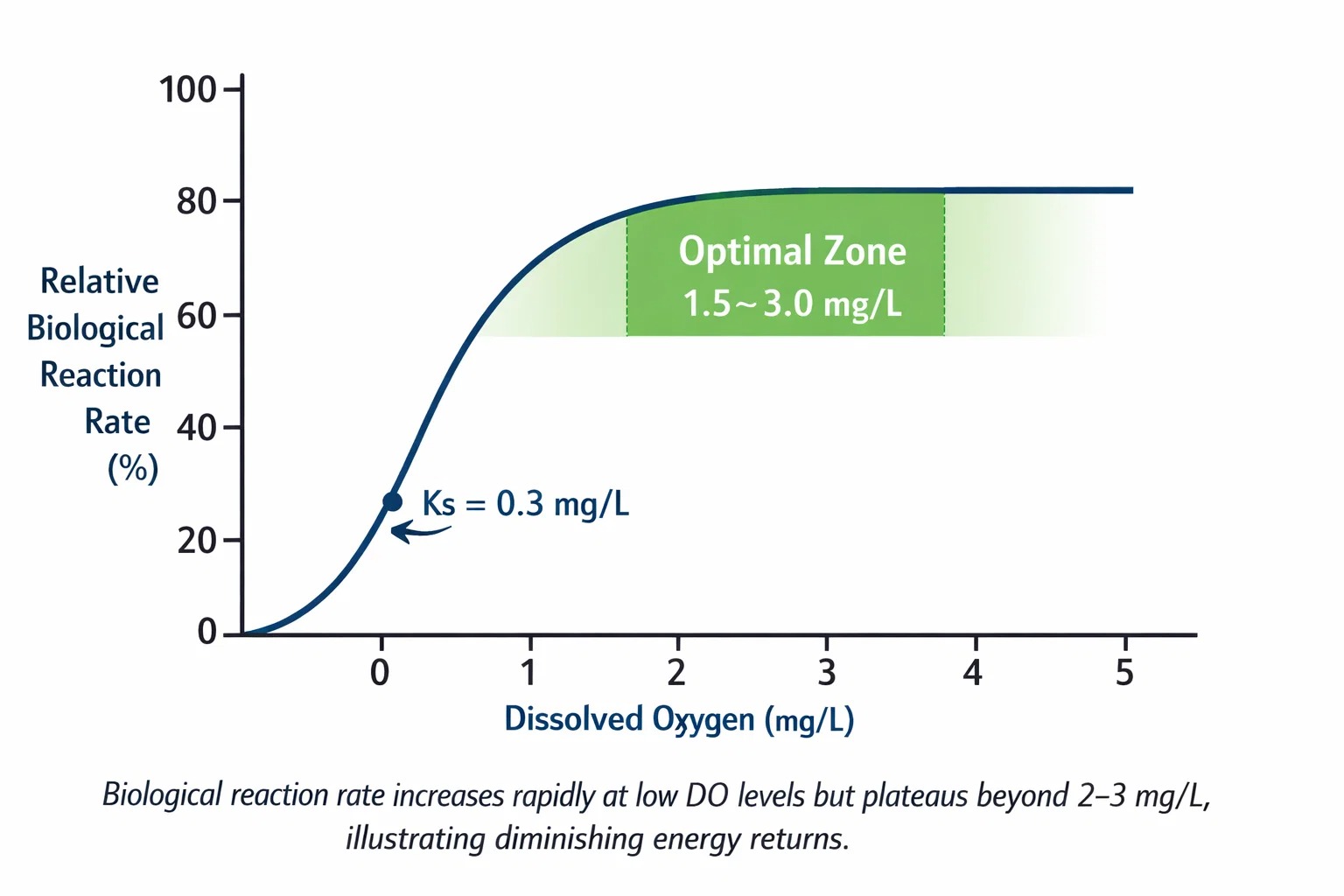
Biological growth follows Monod kinetics, which describes how substrate or oxygen concentration limits reaction speed.
Growth rate ∝ DO / (Ks + DO)
Where:
When DO increases:
• Below 0.5 mg/L → oxygen limits reaction speed
• Between 1.5–3.0 mg/L → optimal operating range
• Above 3.0 mg/L → minimal performance gain but higher energy cost
This explains why most treatment plants target 1.5–3.0 mg/L DO.
Low oxygen creates measurable operational risks:
• DO < 0.5 mg/L → nitrification collapse
• ORP < –100 mV → anaerobic conditions
• Sludge bulking probability increases
• Effluent NH₄-N spikes
Even 1–2 hours of oxygen interruption can destabilize high-load industrial systems.
Aeration typically accounts for:
• 40–60% of total plant electricity consumption
• Up to 70% in nitrification-intensive systems
Example scenario:
Plant capacity: 20,000 m³/day
Oxygen demand: 2,500 kg/day
Improving oxygen transfer efficiency from 2.0 to 3.5 kg O₂/kWh
→ Annual savings: 200,000+ kWh
Small efficiency gains scale into significant long-term OPEX reductions.
Aeration is not simply “adding air.”
It is a balance between:
• Oxygen demand
• Energy consumption
• Mixing requirements
• Sludge characteristics
Correct aeration design ensures treatment stability and lifecycle cost optimization.
Aeration technologies are classified by how oxygen is transferred into water: diffused air systems, mechanical aeration, and jet aeration.
Each technology differs in oxygen transfer efficiency, depth suitability, capital cost, and energy performance.
Selecting the wrong type can increase lifecycle cost by 20–40%.
Diffused aeration uses blowers and submerged diffusers to release air as bubbles.
It is the dominant technology in modern municipal plants.
Air is forced through membrane or ceramic diffusers. Smaller bubbles create larger surface area and longer contact time.
• Fine bubble diameter: 1–3 mm
• Coarse bubble diameter: 4–10 mm
• Optimal tank depth: 4–8 m
• SOTE (fine bubble): 25–35%
• Energy efficiency: up to 6.5 kg O₂/kWh
Fine bubble systems provide 2–3× higher oxygen efficiency than coarse bubble systems.
• Municipal activated sludge
• Industrial biological reactors
• Deep aeration tanks
• Energy-optimized plants
Mechanical aerators transfer oxygen by agitating the water surface.
They rely on turbulence instead of fine bubble diffusion.
An impeller or rotor throws water into the air, increasing air-water contact.
• Oxygen efficiency: 1.5–3.0 kg O₂/kWh
• Effective depth: 2–4 m
• Mixing strength: high
• Installation: simple
• Oxidation ditches
• Lagoons
• Retrofit projects
• Facilities prioritizing simplicity over efficiency
Mechanical systems are typically less energy-efficient than fine bubble systems but easier to maintain.
Jet aeration uses high-velocity liquid jets to entrain air and mix it into water.
A pump creates negative pressure, drawing air into the water stream through a venturi nozzle.
• Depth capability: up to 10 m
• Oxygen efficiency: 2.0–4.0 kg O₂/kWh
• Excellent mixing
• Suitable for high-load wastewater
• Industrial wastewater
• High-solids applications
• Equalization tanks
• Deep reactors
Jet systems balance mixing power and oxygen efficiency.
| Technology | Oxygen Efficiency (kg O₂/kWh) | Typical Depth | Energy Rank | Mixing Strength | CAPEX Level |
|---|---|---|---|---|---|
| Fine Bubble Diffuser | 2.5–6.5 | 4–8 m | High | Moderate | Medium |
| Coarse Bubble | 1.2–2.5 | 3–6 m | Low | High | Low |
| Mechanical Surface | 1.5–3.0 | 2–4 m | Medium | Very High | Medium |
| Jet Aeration | 2.0–4.0 | 4–10 m | Medium–High | High | Medium–High |
Fine bubble systems dominate in energy-sensitive plants.
Mechanical systems dominate in simplicity-driven installations.
Jet systems dominate in mixing-intensive industrial environments.
Selection depends on:
• Required oxygen transfer rate (kg O₂/hr)
• Tank geometry and depth
• MLSS concentration
• Energy cost per kWh
• Maintenance accessibility
Rule of thumb:
If energy optimization is the priority → Fine bubble diffusers.
If mixing strength is priority → Mechanical or jet systems.
If tank depth > 6 m → Diffused or jet systems preferred.
Nihaowater focuses primarily on engineered diffuser-based aeration systems, optimized for:
• Uniform air distribution
• High SOTE performance
• Industrial durability materials
• Custom airflow layout design
The emphasis is not just diffuser supply, but system-level oxygen efficiency optimization.
Aeration system design is governed by quantifiable parameters that ensure sufficient oxygen transfer, optimal mixing, and energy efficiency.
Poor design increases OPEX by 20–40% and can compromise treatment performance.
Definition: OTR is the mass of oxygen transferred to water per unit time (kg O₂/hr).
Formula (simplified):
OTR = Q_air × C_sat × α × β
Where:
Typical design target:
Definition: The fraction of oxygen actually transferred to water under standard conditions (clean water, 20°C).
| Diffuser Type | SOTE (%) |
|---|---|
| Fine Bubble | 25–35 |
| Coarse Bubble | 8–15 |
| Mechanical Surface | 10–20 |
| Jet Aeration | 15–25 |
SOTE is used with OTR to calculate blower capacity and energy consumption.
Definition: The volume of air supplied per unit time (Nm³/h).
Design considerations:
Rule of thumb:
Visualizable parameter: Bubble rise path vs dissolved oxygen efficiency.
| Technology | Typical Efficiency |
|---|---|
| Fine Bubble Diffuser | 2.5–6.5 |
| Coarse Bubble | 1.2–2.5 |
| Mechanical Surface | 1.5–3.0 |
| Jet Aeration | 2.0–4.0 |
Optimization:
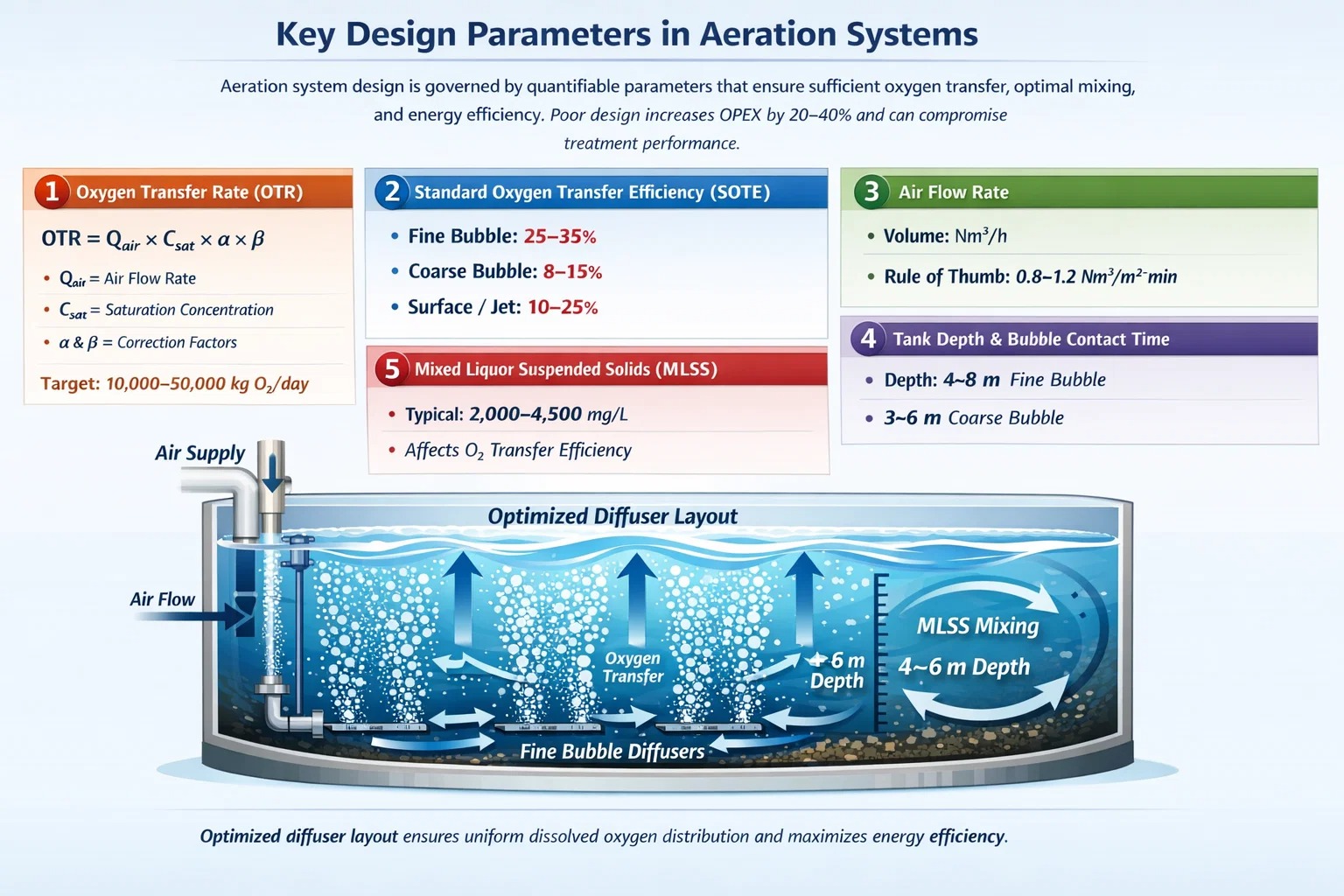
Key takeaway: Blower sizing is directly tied to oxygen demand, tank geometry, and diffuser performance.
Conclusion: A well-designed aeration system integrates all these parameters to achieve stable treatment, uniform DO, and minimal energy consumption.
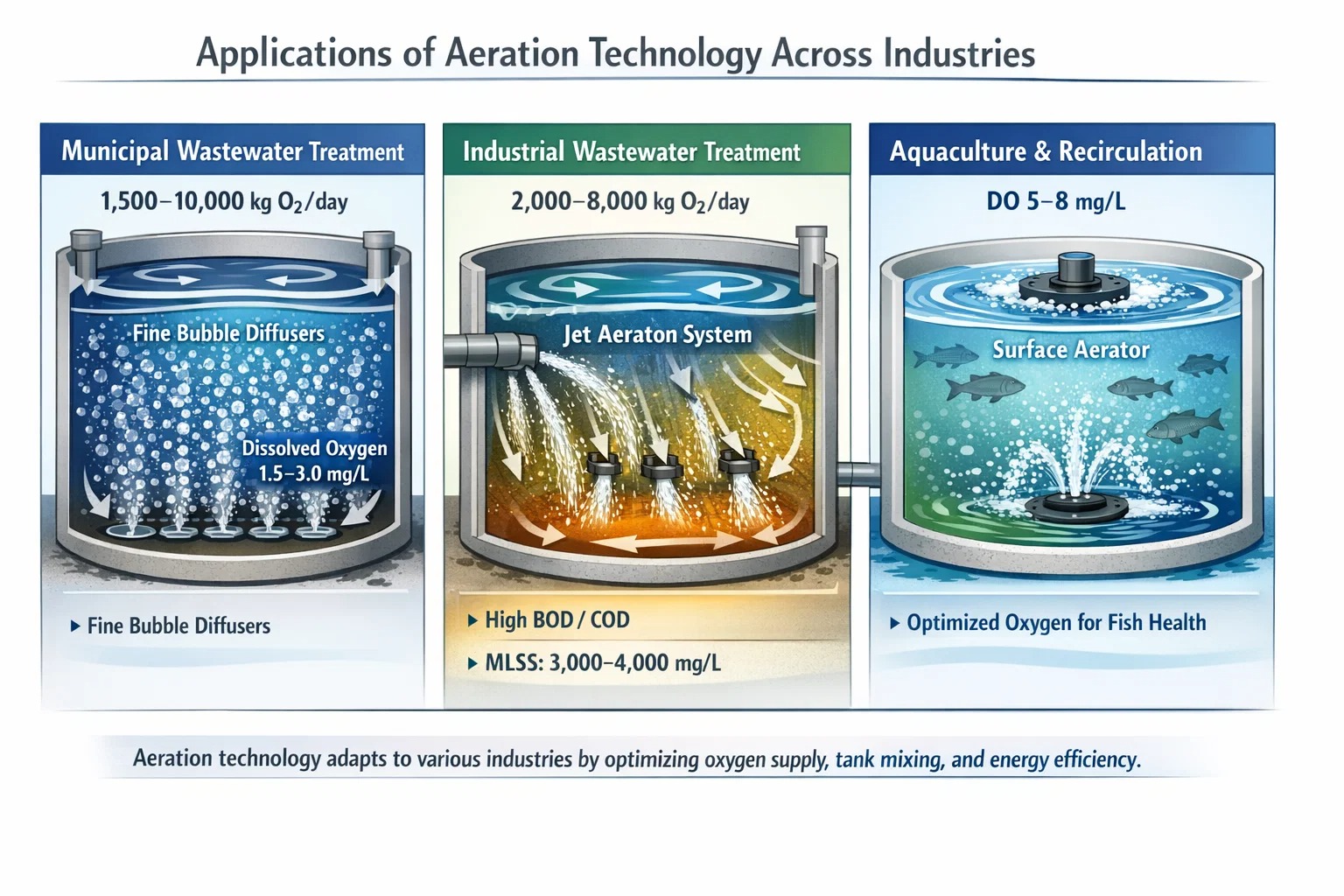
Aeration technology is essential in municipal and industrial wastewater treatment, aquaculture, and process water management.
It provides oxygen for biological treatment, prevents anaerobic zones, and ensures process stability across diverse applications.
Case Example:
Medium-sized municipal plant, 20,000 m³/day
| Industry | Typical Wastewater | Aeration Tech | Oxygen Demand (kg O₂/day) | MLSS (mg/L) |
|---|---|---|---|---|
| Food & Beverage | High BOD, low solids | Fine bubble / Jet | 2,000–10,000 | 3,000–4,000 |
| Textile | Color, COD-heavy | Fine bubble / Jet | 1,500–8,000 | 2,500–3,500 |
| Pharmaceutical | High COD/NH₄⁺ | Jet / Fine bubble | 1,000–5,000 | 3,000–4,500 |
| Pulp & Paper | High solids & BOD | Jet / Mechanical | 5,000–20,000 | 4,000–5,000 |
Observation:
Aeration systems are energy-intensive and technically critical. Common operational issues can reduce oxygen transfer efficiency, increase energy costs, and compromise effluent quality.
Identifying and correcting these issues is essential for stable biological treatment.
| Problem | Indicators / Thresholds | Likely Cause | Recommended Solution |
|---|---|---|---|
| Low Dissolved Oxygen | DO < 1.0 mg/L in aeration tank | Diffuser clogging, blower underperformance, uneven airflow | Clean diffusers, check blower output, rebalance air distribution |
| Diffuser Fouling | Pressure drop >10–15% or visible blockage | Biofilm, scaling, debris | Regular backwashing, chemical cleaning, install strainers |
| Uneven Mixing | MLSS gradient >10–15% across tank | Poor diffuser layout, shallow tank, low airflow | Adjust diffuser layout, increase airflow, consider mechanical mixers |
| Excessive Energy Use | kWh/kg O₂ > design target | Over-aeration, high blower speed, inefficient diffuser | Optimize airflow, install VFD control, upgrade diffusers |
| Nitrification Failure | NH₄⁺-N > 2 mg/L effluent | DO < 1.5 mg/L, short-circuiting, high load | Increase DO, optimize mixing, balance hydraulic load |
| Sludge Bulking | SVI > 150 mL/g | Filamentous growth, low DO | Maintain DO ≥ 1.5 mg/L, monitor nutrient balance, consider selector zones |
| Noise / Vibration | >80 dB near aeration equipment | Mechanical imbalance, cavitation | Inspect rotating parts, maintain bearings, proper mounting |
| Parameter | Optimal Range | Notes |
|---|---|---|
| DO | 1.5–3.0 mg/L | Maintains biological activity without energy waste |
| MLSS | 2,000–4,500 mg/L | Ensures adequate biomass concentration |
| SVI (Sludge Volume Index) | 80–120 mL/g | Predicts settling quality |
| Blower Pressure | As per diffuser spec | Prevents over/under aeration |
| Airflow Distribution | ±10% uniformity | Critical for tank-wide oxygen delivery |
Aeration technology is the backbone of effective biological wastewater treatment.
It controls oxygen supply, mixing, and energy consumption, directly impacting BOD/COD removal, nitrification, and sludge stability.
Oxygen Transfer: Fine bubble diffusers achieve 25–35% SOTE; oxygen demand must match biological load.
DO Control: Maintain 1.5–3.0 mg/L for optimal microbial kinetics; below 0.5 mg/L risks nitrification collapse.
Energy Efficiency: Aeration accounts for 40–60% of plant electricity; optimizing OTR and diffuser layout can reduce consumption by 15–35%.
System Selection:
Design Parameters: Tank depth, MLSS, airflow, OTR, SOTE, alpha factor, and blower control are interdependent for performance optimization.
Operational Monitoring: DO, MLSS, SVI, and airflow uniformity are critical for early problem detection.



86-15267462807


86-15267462807
