


 English
 عربى
عربى
 Español


×
Password
Get password
Enter password to download relevant content.
Submit
 +86-15267462807
Aquaculture wastewater treatment is becoming more important as fish farms, shrimp farms, hatcheries, and recirculating aquaculture systems expand worldwide. One of the most critical water quality problems in aquaculture is ammonia. If ammonia is not controlled, it can stress aquatic animals, reduce growth, increase disease risk, and damage the stability of the whole farming system.
MBBR media offers a practical way to improve ammonia removal in aquaculture wastewater. By providing a protected surface for nitrifying bacteria, moving bed biofilm reactor media helps convert toxic ammonia into less harmful nitrogen forms through biological nitrification.
Ammonia in aquaculture systems mainly comes from fish and shrimp metabolism, uneaten feed, feces, and decomposing organic matter. In intensive farming systems, the ammonia load can rise quickly because more animals are kept in a smaller water volume.
Ammonia exists in water mainly as:
The balance between NH3 and NH4+ depends on pH and temperature. When pH and temperature rise, the toxic NH3 fraction increases. This is why ammonia control is especially important in warm-water aquaculture and high-density systems.
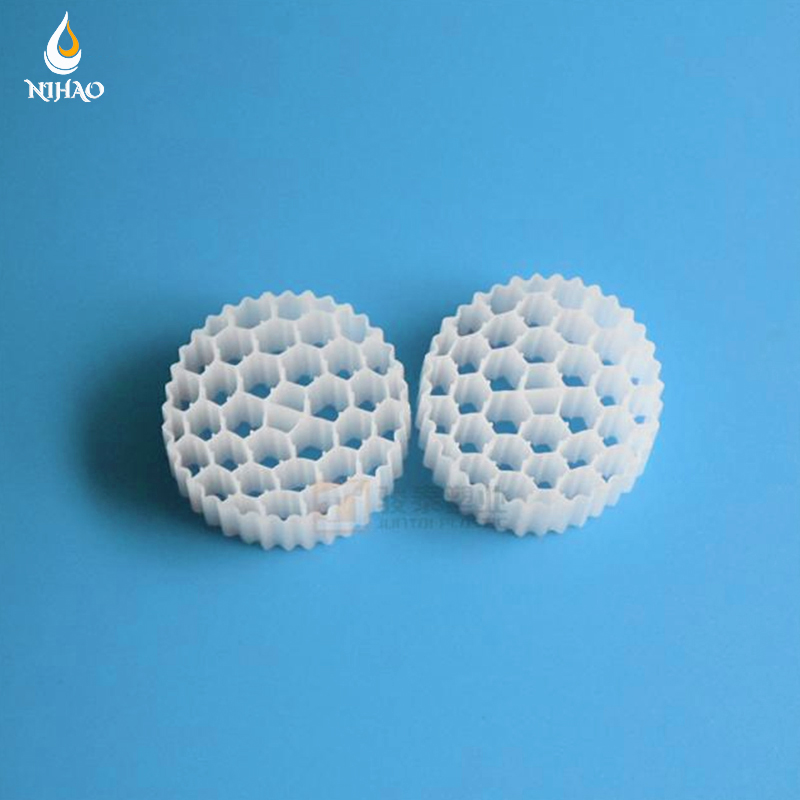
MBBR media is a plastic biofilm carrier used inside a moving bed biofilm reactor. The carriers move freely in the tank with the help of aeration or water mixing. Their protected inner surface allows beneficial microorganisms to attach and grow.
In aquaculture wastewater treatment, MBBR media is mainly used as a biological filter. It supports nitrifying bacteria that remove ammonia from water.
The process usually follows two biological steps:
| Step | Main Function | Result |
|---|---|---|
| Nitrification step 1 | Ammonia-oxidizing bacteria convert ammonia to nitrite | NH3 / NH4+ becomes NO2- |
| Nitrification step 2 | Nitrite-oxidizing bacteria convert nitrite to nitrate | NO2- becomes NO3- |
Nitrate is much less toxic than ammonia and nitrite, and it can be controlled through water exchange, denitrification, aquatic plants, or further treatment depending on the farm design.
Aquaculture systems need stable biological treatment because the water environment directly affects animal health. MBBR media is suitable for this application for several reasons.
First, it provides a high specific surface area for biofilm growth. This allows more nitrifying bacteria to live inside a compact tank volume.
Second, the biofilm is more stable than suspended biomass in many operating conditions. Bacteria grow on the media surface instead of being easily washed out of the system.
Third, MBBR systems are relatively easy to expand. If ammonia load increases because of higher stocking density or feed input, the system can often be upgraded by increasing carrier filling ratio, aeration capacity, or reactor volume.
Fourth, moving bed biofilm reactors can be used in both new aquaculture wastewater treatment plants and retrofit projects.
A complete aquaculture wastewater treatment system normally uses several treatment steps. MBBR media is important, but it is not the only part of the process.
A common process flow is:
For farms with high suspended solids, pre-treatment is important. Too much organic solid load can consume oxygen, clog equipment, and reduce the performance of the biofilm reactor.
When selecting MBBR media for aquaculture wastewater treatment, buyers should compare more than just the price per cubic meter. The performance depends on carrier design, material quality, usable protected surface area, movement in water, and long-term durability.
Important selection factors include:
| Factor | Why It Matters |
|---|---|
| Specific surface area | More usable area supports more biofilm growth |
| Protected surface design | Helps keep nitrifying bacteria from being damaged by collision and mixing |
| Material | HDPE and similar materials are commonly used for chemical resistance and durability |
| Carrier density | Media should move well in water without sinking or floating as a fixed layer |
| Filling ratio | Affects treatment capacity, oxygen demand, and mixing requirements |
| Aeration design | Nitrification needs enough dissolved oxygen |
For aquaculture, stable movement is especially important. If the media does not circulate properly, part of the biofilm may receive less oxygen, and ammonia removal can become unstable.
MBBR ammonia removal performance depends on water quality, temperature, pH, dissolved oxygen, hydraulic retention time, ammonia loading rate, and biofilm maturity.
Important design points include:
In many aquaculture systems, startup is a sensitive period. Nitrifying bacteria grow more slowly than many other microorganisms, so the system may need several weeks to develop stable ammonia removal capacity.
| Problem | Possible Cause | Suggested Check |
|---|---|---|
| Ammonia remains high | Biofilm not mature, low DO, overload, wrong media volume | Check startup time, DO, feed input, and carrier filling ratio |
| Nitrite accumulates | Nitrite-oxidizing bacteria not established or oxygen is insufficient | Test nitrite, DO, pH, and alkalinity |
| Media does not move evenly | Aeration layout or water mixing is poor | Check diffuser position and airflow distribution |
| Biofilm is too thick | Excess organic load or weak shear force | Improve pre-treatment and mixing |
| Fish stress continues after ammonia drops | Nitrite, pH, oxygen, or other water quality problems | Test full water quality profile |
MBBR media can be applied in many aquaculture scenarios, including:
It is especially useful where the farm needs higher biological treatment capacity but has limited space.
Aquaculture is moving toward higher stocking density, better water control, lower water exchange, and more efficient resource use. These changes increase the need for reliable biological filtration.
For many farms, ammonia control is not only an environmental requirement. It is directly connected to survival rate, feed conversion, growth performance, and production stability.
MBBR media helps farms build a compact and flexible biofilm system for ammonia removal. When combined with proper solids removal, aeration, monitoring, and sludge handling, it can improve both wastewater treatment performance and aquaculture water quality management.
Yes. MBBR media supports nitrifying bacteria that convert ammonia into nitrite and then nitrate. The actual removal efficiency depends on media volume, dissolved oxygen, temperature, pH, ammonia loading, and biofilm maturity.
MBBR systems are often easier to mix and expand than fixed biofilters. Because the carriers move in the reactor, the biofilm receives oxygen and substrate more evenly. However, the best choice depends on the farm layout, flow rate, solids load, and maintenance requirements.
Startup time varies, but nitrifying biofilm usually needs several weeks to develop. Warm temperature, stable pH, enough alkalinity, good dissolved oxygen, and controlled ammonia loading can help the biofilm establish more smoothly.
Yes, if the second stage of nitrifying bacteria is well established. Nitrite removal can be slower during startup, so farms should monitor nitrite closely before the biofilter becomes stable.
Yes. MBBR media can be used in shrimp farming systems to support biological ammonia and nitrite control. Good solids management, aeration, and water quality monitoring are still necessary.
Common supporting equipment includes screens, drum filters, sedimentation tanks, aeration diffusers, blowers, media retention screens, polishing filters, disinfection units, and sludge dewatering equipment.
Ammonia removal is one of the most important parts of aquaculture wastewater treatment. MBBR media provides a high-surface-area home for nitrifying bacteria, helping farms convert toxic ammonia into less harmful nitrogen forms.
For fish farms, shrimp farms, hatcheries, and recirculating aquaculture systems, a well-designed MBBR biofilter can improve water quality stability, support higher production density, and reduce the risks caused by ammonia and nitrite accumulation.



86-15267462807


86-15267462807
