


 English
 عربى
عربى
 Español


×
Password
Get password
Enter password to download relevant content.
Submit
 +86-15267462807
Managing total ammonia nitrogen (TAN) in modern aquaculture—particularly in high-density Recirculating Aquaculture Systems (RAS)—requires robust, space-efficient biological filtration. Moving Bed Biofilm Reactor (MBBR) technology has emerged as the industry standard for continuous nitrification. However, optimizing an MBBR requires moving beyond surface-level claims and looking directly at carrier physics, temperature-adjusted reaction kinetics, and rigorous reactor design formulas.
In aquaculture systems, toxic ammonia (NH3) excreted by fish or shrimp must be oxidized to nitrite (NO2-) and subsequently to relatively harmless nitrate (NO3-). MBBR media operates by providing a protected, high-surface-area habitat for slow-growing nitrifying bacteria—primarily Ammonia-Oxidizing Bacteria (AOB) and Nitrite-Oxidizing Bacteria (NOB)—to form an active biofilm.
Unlike conventional suspended activated sludge, which is vulnerable to washouts and physical sloughing during flow surges, MBBR carriers remain within the reactor vessel via outlet retention strainers. The continuous movement of the carriers—driven by coarse-bubble aeration or mechanical mixers—creates controlled hydrodynamic shear forces. These forces scrub away outer dead biomass, maintaining a thin, highly active biofilm layer typically between 100 to 300 microns thick. During the initial startup phase, biofilm colonization follows a predictable lag period where ammonia removal fluctuates until the microbial matrix fully matures.
Key physical parameters used by design engineers to evaluate MBBR performance include:
In US regulatory frameworks, such as state-issued National Pollutant Discharge Elimination System (NPDES) permits, MBBR systems provide crucial stability by preventing unexpected ammonia spikes in final discharge streams.
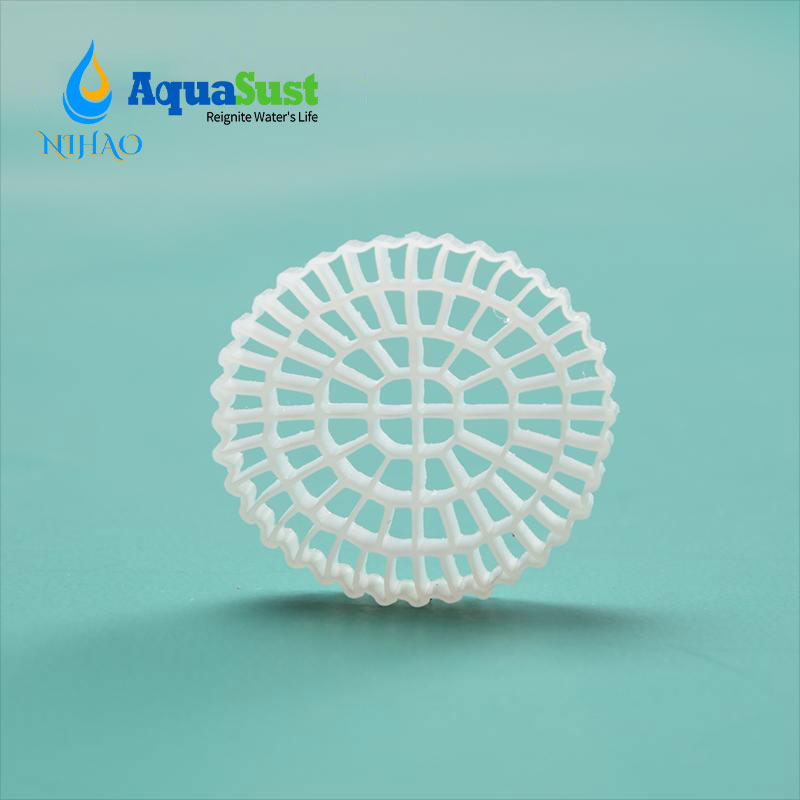
Selecting the correct MBBR carrier involves balancing hydraulic transport, biofilm protection, structural durability, and capital expenditure. Generic media often fails due to internal clogging or high wear rates under continuous agitation.
| Selection Parameter | Recommended Target / Engineering Range | Impact on Aquaculture Operations |
|---|---|---|
| Protected Surface Area (SSA) | 500 to 1200 m2/m3 | Higher SSA reduces required tank footprint; lower SSA provides wider channels resistant to bio-clogging. |
| Media Geometry & Voidage | Chip/wheel shape with >85% void fraction | Ensures rapid internal fluid exchange and prevents localized solids entrapment. |
| Material Grade & Density | 100% Virgin HDPE (Density: 0.95 to 0.98 g/cm3) | Prevents chemical leaching; density close to water guarantees fluidization with minimal energy. |
| Abrasion & Lifespan | High tensile strength; >15-20 year design life | Resists continuous friction in marine or freshwater conditions without microplastic shedding. |
For aquaculture applications, virgin food-grade High-Density Polyethylene (HDPE) is mandatory to ensure zero toxic chemical leaching into live fish stock. Additionally, modular carrier designs allow farm operators to expand treatment capacity simply by increasing the media fill fraction without constructing new concrete tanks.
Nitrification performance in an MBBR is measured by the Surface Area Loading Rate (SALR) or Surface Area Removal Rate (SARR), expressed as g NH3-N/m2/day. Typical design rates in warm-water aquaculture range from 0.5 to 1.2 g NH3-N/m2/day, whereas cold-water systems often operate between 0.2 and 0.5 g NH3-N/m2/day.
Real-world SARR depends directly on operational drivers:
Automated online monitoring of ammonia (NH4+), nitrite (NO2-), and nitrate (NO3-) provides real-time operational feedback. High-frequency sampling alerts operators instantly if TAN approaches critical threshold limits (e.g., >1.0 mg/L TAN in commercial RAS).
Sizing an aquaculture MBBR requires a step-by-step conversion from daily feed inputs to total required carrier volume.
Recommended Hydraulic Retention Time (HRT) typically falls between 15 to 45 minutes depending on loop flow rates. Continuous mixing requires an aeration power supply of roughly 20 to 30 W/m3 of reactor volume (or air airflow rates of 0.3 to 0.55 m3 air/m3 tank volume per minute) to maintain fluidization without damaging media structural integrity.
A structured approach to commissioning, routine maintenance, and troubleshooting ensures stable long-term performance and high return on investment (ROI).
Fresh HDPE media is hydrophobic. Achieving stable biological conversion follows a standard timeline:
| Observed Issue | Root Cause Analysis | Corrective Action SOP |
|---|---|---|
| Nitrite (NO2-) Spike | NOB inhibition due to low DO or temporary free ammonia (FA) toxicity. | Increase aeration to boost DO above 5.0 mg/L; reduce feeding rate by 25-50% temporarily. |
| Mass Biofilm Sloughing | pH drop below 6.5 or sudden temperature/salinity shock. | Dose sodium bicarbonate to restore pH to 7.5; stabilize water parameters gradually. |
| Carrier Dead Zones | Insufficient air distribution or uneven hydraulic inlet distribution. | Inspect coarse-bubble diffusers; re-align aeration pattern to restore full media suspension. |
Retrofitting an existing aquaculture system with MBBR modules requires minimal infrastructure modification. Operators can insert external MBBR tank loops or slip-in media baskets directly into existing sump channels, instantly scaling treatment capacity with significantly lower capital cost compared to replacing complete filter setups.
Optimizing your aquaculture wastewater setup reduces mortality risks and improves overall feed conversion ratios (FCR). Request a tailored system assessment to analyze your farm's nitrogen load and receive a custom MBBR design layout.
Contact our engineering support team today to receive:
DO levels should be maintained between 4.0 and 6.0 mg/L directly inside the MBBR reactor. Aeration rates generally require 20 to 30 W of power per cubic meter of reactor tank volume to satisfy microbial oxygen demand and ensure proper carrier fluidization.
Calculate total daily TAN output, divide by your media's Surface Area Removal Rate (g NH3-N/m2/day) to find required media surface area, then divide by media SSA (m2/m3). Scale tank size according to a 40% to 60% media fill fraction. Design for an HRT between 15 and 45 minutes.
Typical rates range from 0.8 to 1.2 g NH3-N/m2/day at 20 to 25 degrees C, but drop to 0.2 to 0.4 g NH3-N/m2/day at temperatures below 10 degrees C. Use Arrhenius kinetic models to scale required carrier volume up during colder operating months.
Natural colonization typically takes 3 to 5 weeks. Startup can be accelerated to 10 to 14 days by pre-soaking media in wastewater, dosing specialized nitrifying bacterial cultures, and maintaining water temperatures near 22 to 25 degrees C with stable alkalinity.
Monitor NO2- daily using online ion-selective electrodes or colorimetric tests. Manage spikes by boosting aeration and maintaining alkalinity. An anoxic denitrification stage is required when recirculating water accumulates nitrate (NO3-) above species tolerance limits (typically >50-100 mg/L NO3-N).
Routine maintenance involves auditing aeration diffusers and checking outlet strainers monthly. Quality virgin HDPE media carries a lifespan exceeding 15 to 20 years. Because MBBR requires no backwashing and experiences low head-loss, operational lifecycle costs are up to 30% lower than SBR or fixed-bed filters.



86-15267462807


86-15267462807
