In the design of modern wastewater treatment plants—especially those utilizing Membrane Bioreactor (MBR) technology—the choice of aeration system is one of the most critical decisions. While surface aerators have long been a staple in traditional lagoons, Fine Bubble Disc Diffusers (submerged aeration) have become the gold standard for MBR applications.
Here is a technical comparison of why submerged disc diffusers outperform surface aeration in high-performance treatment environments.
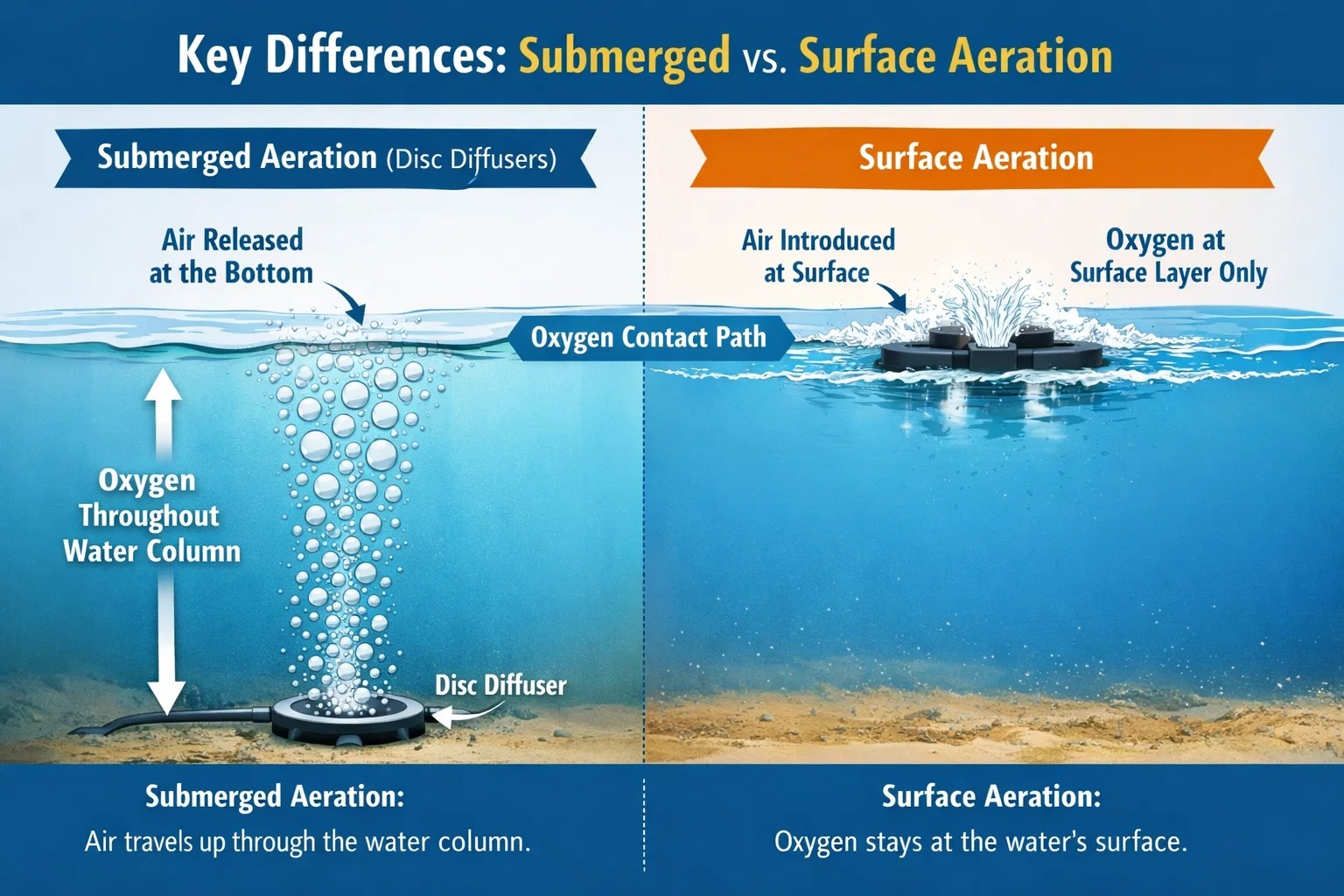
Key Differences: Submerged vs. Surface Aeration
Where the Air Enters the Water
- Submerged aeration (e.g., disc diffusers) releases air from the bottom or within the mixed liquor so oxygen is delivered throughout the water column.
- Surface aerators introduce oxygen at the water’s surface by splashing or agitation.

Because MBR systems typically operate in deep, dense mixed liquor, submerged methods allow bubbles to rise through the entire depth, increasing oxygen contact time and more uniform aeration.
1. Oxygen Transfer Efficiency (OTE)
The primary goal of aeration is to move oxygen from the air into the liquid.
- Surface Aerators: These machines work by splashing water into the air. The contact time between air and water is extremely short, occurring only at the surface.
- Disc Diffusers: By releasing millions of fine bubbles at the bottom of the tank, disc diffusers utilize the entire water column. As bubbles rise, they transfer oxygen throughout the journey.
- The MBR Factor: MBR tanks are typically deep ( to meters) to save space. Disc diffusers gain efficiency with depth (higher SOTE per meter), whereas surface aerators struggle to oxygenate the bottom of deep tanks.
2. Managing High MLSS Concentrations
MBR systems operate at significantly higher Mixed Liquor Suspended Solids (MLSS) levels—usually between and mg/L—compared to conventional systems ( mg/L).
- Viscosity Challenges: High MLSS makes wastewater more viscous (thicker). Surface aerators often fail to provide enough localized energy to penetrate this thick sludge, leading to “dead zones” where solids settle and turn anaerobic.
- Submerged Precision: Disc diffusers are arranged in a grid across the floor. This provides uniform mixing and ensures that every liter of high-density sludge receives adequate dissolved oxygen (DO), regardless of viscosity.
3. Impact on Membrane Health and Foaming
In an MBR system, the aeration system doesn’t just feed bacteria; it interacts with the sensitive membrane modules.
- Aerosols and Foaming: Surface aerators create significant splashing and aerosols. In industrial or pharmaceutical wastewater, this can lead to excessive foaming and the release of Volatile Organic Compounds (VOCs) into the atmosphere.
- Gentle Interaction: Disc diffusers provide “sub-surface” turbulence. The fine bubbles rise gently, providing the necessary “scouring” effect if placed beneath membrane modules, which helps keep the membranes clean without the violent mechanical action of a surface impeller.
4. Energy Consumption and Heat Loss
Aeration typically accounts for 45% to 75% of a treatment plant’s energy costs.
- Blower Efficiency: Disc diffusers paired with high-efficiency blowers can be throttled precisely using VFDs (Variable Frequency Drives) based on real-time DO sensors.
- Thermal Management: Surface aerators expose the wastewater to the ambient air. In winter, this causes massive heat loss, which slows down biological activity. In summer, it can overheat the water. Submerged aeration keeps the process temperature stable.
Comparison Summary: Disc Diffusers vs. Surface Aerators
| Feature |
Surface Aerators |
Fine Bubble Disc Diffusers |
| Oxygen Transfer |
Low (– kg /kWh) |
High (– kg /kWh) |
| Tank Depth |
Limited to shallow tanks |
Ideal for deep (m+) tanks |
| Maintenance |
Mechanical (motor/gearbox) |
Membrane (periodic cleaning) |
| MBR Compatibility |
Poor (Foaming/Dead zones) |
Excellent (Uniform mixing/Scouring) |
| Aerosol Risk |
High |
Negligible |
Conclusion
For an MBR system, the choice is clear. Fine Bubble Disc Diffusers provide the superior oxygen transfer, deep-tank mixing, and energy efficiency required to maintain a high-density biomass. While surface aerators may be simpler to install in open lagoons, they lack the precision and power required for the high-intensity environment of a modern pharmaceutical or chemical MBR plant.