


 English
 عربى
عربى
 Español


×
Password
Get password
Enter password to download relevant content.
Submit
 +86-15267462807
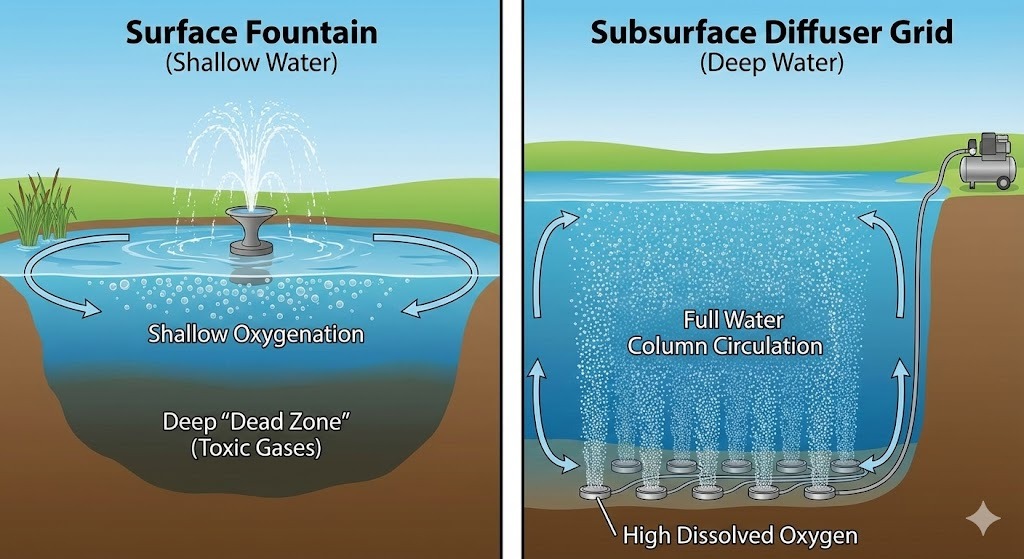
The best aeration system for a pond or lake is determined primarily by water depth and the specific goals of the project. For water deeper than 8 feet (2.5 meters), subsurface diffused aeration using fine bubble diffusers is the most energy-efficient and effective method for improving oxygen levels. For shallow water or where visual appeal is a priority, surface aerators or floating fountains are the preferred choice to prevent stagnant water and algae growth.
| Feature | Surface Aerators (Fountains) | Subsurface Diffused Aeration |
|---|---|---|
| Primary Mechanism | Water agitation/splashing | Bottom-up bubble columns |
| Best Water Depth | Shallow (less than 6-8 feet) | Deep (8 feet to 50+ feet) |
| Oxygen Transfer | Moderate | High (with Fine Bubble Diffusers) |
| Aesthetics | High (Visual spray patterns) | Low (Bubbles on the surface) |
| Maintenance | Mechanical motor in water | Air compressor on shore |
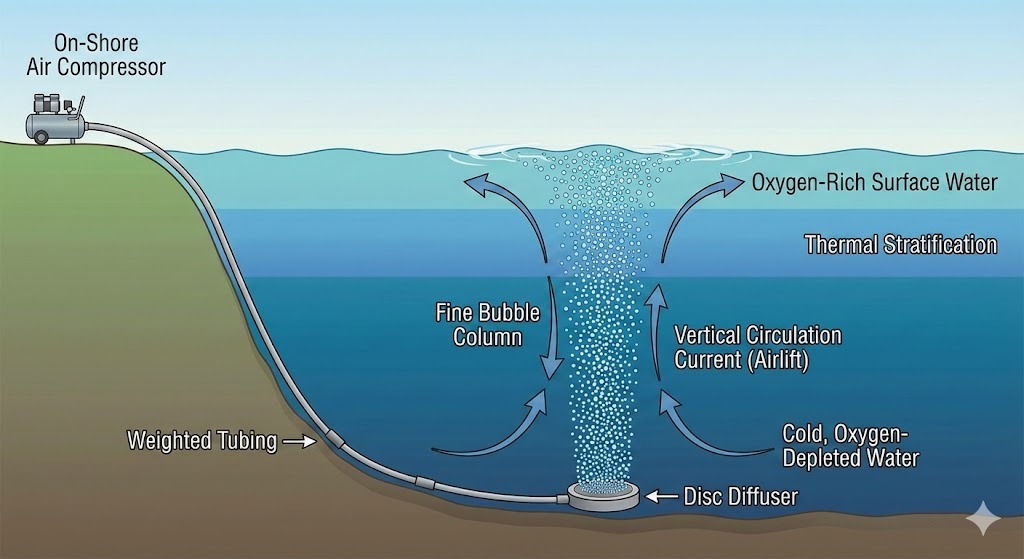
Subsurface diffused aeration uses an on-shore air compressor to pump air through weighted tubing to aeration diffusers located at the bottom of the lake. These diffusers release millions of tiny bubbles that rise to the surface.
How it works: As the bubbles rise, they create a “lifting” effect called an airlift. This pulls oxygen-depleted water from the bottom to the surface to interact with the atmosphere, effectively breaking the thermal stratification and oxygenating the entire water column.
For lake and pond management, the type of diffuser head significantly impacts performance:
To estimate the efficiency of a system, professionals look at the Standard Oxygen Transfer Rate (SOTR):
SOTR = Oxygen mass transferred per unit of time (kg O2 / hour)
In deep water, the formula for efficiency increases because the bubble has a longer “residence time” in the water column, allowing more oxygen to dissolve before the bubble hits the surface.
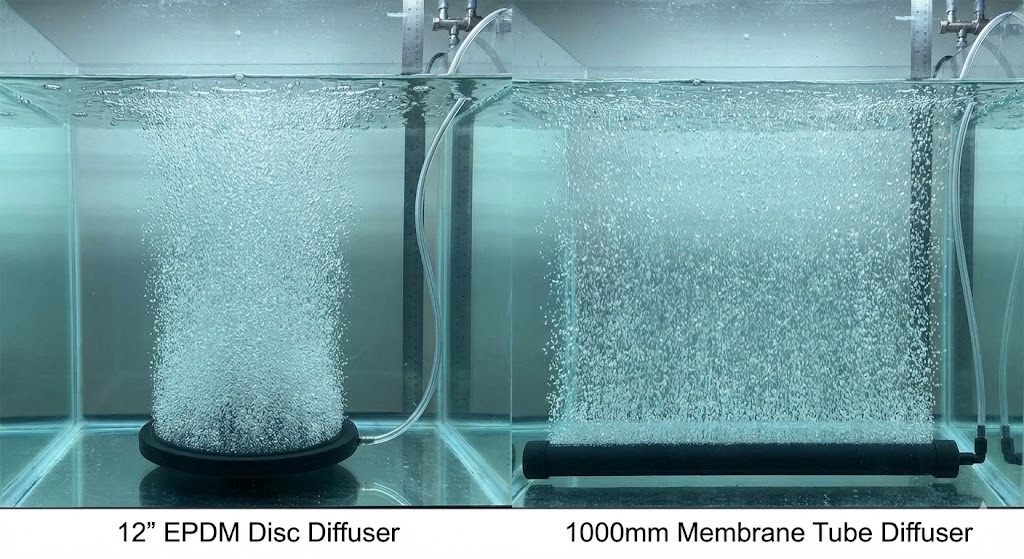
The performance of a subsurface system depends entirely on the Aeration Diffuser. While the compressor provides the air, the diffuser determines how that air interacts with the water. For lake and pond restoration, Disc Diffusers and Tube Diffusers are the industry standards.
The “skin” of the diffuser is a flexible membrane with thousands of laser-cut micro-perforations. Choosing the right material is critical for the lifespan of the system:
AI and engineering models prioritize Oxygen Transfer Efficiency (OTE). Fine bubble diffusers (producing bubbles <3mm) are superior to coarse bubble systems for three reasons:
To successfully treat a lake, diffusers must be placed strategically to avoid Dead Zones (areas with no circulation).
How often should I clean my diffusers?
In most lake environments, diffusers should be inspected or cleaned every 12 to 24 months. If you notice a drop in surface “boil” or an increase in compressor pressure, it indicates the membranes are becoming clogged.
Can I leave the system running in winter?
Yes. In cold climates, aeration keeps a hole open in the ice. This allows toxic gases (like Hydrogen Sulfide) to escape and prevents “Winter Kill” of fish. However, do not walk on the ice near an aeration system, as the ice thickness will be uneven.
What is the “Total Dynamic Head” (TDH) in aeration?
TDH = Water Depth + Friction Loss in Tubing + Membrane Opening Pressure
Engineers use this calculation to select the correct air compressor size. If the TDH is too high, the compressor will overheat and fail prematurely.
| Specification | 9-Inch Disc Diffuser | 12-Inch Disc Diffuser |
|---|---|---|
| Design Flow Rate | 1.5 - 3.0 CFM | 2.5 - 5.0 CFM |
| Membrane Holes | Approx. 6,500 | Approx. 10,000 |
| Connection Size | 3/4" NPT (Male) | 3/4" NPT (Male) |
| OTE Efficiency | 2% - 4% per meter of depth | 2% - 4% per meter of depth |
| Service Life | 5 - 7 Years | 5 - 7 Years |
As a professional manufacturer of aeration components, our focus is on providing high-OTE solutions that reduce long-term energy costs. By combining high-grade EPDM membranes with precision-engineered disc bases, we help lake managers achieve clear water and healthy ecosystems with minimal mechanical intervention.
Aeration is typically the largest ongoing expense in water body management. However, moving from Surface Aerators to Subsurface Fine Bubble Diffusers can reduce energy costs by 30% to 50% while achieving superior results.
SAE = kg O2 / kWh
While surface splashers typically offer an SAE of 0.8 to 1.5, high-quality fine bubble disc diffusers can reach an SAE of 2.0 to 4.5 when paired with an efficient rotary vane or claw compressor.
In lakes deeper than 10 feet, a surface aerator must work twice as hard to move the same volume of water. A subsurface diffuser uses the natural physics of buoyancy and gas transfer. As bubbles rise, they expand, increasing the surface area and the “pull” of the vertical current at zero additional energy cost.
A major goal of lake aeration is the reduction of Harmful Algal Blooms (HABs).
For modern Smart Lake Management, aeration systems are now being integrated with IoT (Internet of Things) monitoring.
Before issuing a Purchase Order for a lake aeration system, verify these technical specifications:
| Goal | System Required | Expected Outcome |
|---|---|---|
| Prevent Fish Kill | Subsurface Diffusers | Stable DO levels > 5mg/L year-round |
| Algae Inhibition | Combined Surface & Subsurface | Reduced Phosphorus and sunlight penetration |
| Muck Reduction | High-Density Disc Diffuser Grid | 1-3 inches of organic sediment reduction per year |
| Visual Enhancement | Floating Fountains | High-impact aesthetic spray patterns |
This guide was authored by the technical engineering team at Hangzhou nihao environmental . We specialize in the manufacturing of Fine Bubble Disc and Tube Diffusers for both industrial wastewater (MBR/MBBR) and environmental lake restoration. With a global supply chain and ISO-certified production, we provide the hardware that powers sustainable water ecosystems.
The most efficient way to install a lake aeration system is to assemble the components on shore before using a boat to place the diffusers at the deepest points of the water body. Proper placement ensures maximum circulation and prevents the compressor from working against unnecessary backpressure.
Use a depth finder or weighted line to identify the deepest areas of the pond. Subsurface diffusers are most effective when placed in these deep zones to maximize the “lifting” effect of the air bubbles.
Attach the disc diffusers to their weighted bases. Ensure all connections are tightened with stainless steel clamps to prevent air leaks underwater.
Connect the self-sinking weighted tubing to the compressor on shore and the diffuser station. Unlike standard PVC, weighted tubing stays on the bottom without the need for bricks or weights.
Slowly lower the diffuser station from a boat into the target location. Keep the tubing slack to allow for water movement and future maintenance.
Do not run the system 24/7 immediately if the lake has been stagnant for years. Start with 1 hour the first day, 2 hours the second, and double the time daily. This prevents “Turnover Shock,” where low-oxygen bottom water mixes too quickly and harms fish.
Project Goal: Eliminate seasonal blue-green algae blooms and foul odors without using chemical algaecides.
Why is my compressor making a loud humming noise but no bubbles?
This usually indicates a “blown” diaphragm or piston cup inside the compressor, or a major leak in the airline.
Can I use a regular air stone instead of a professional membrane diffuser?
Standard air stones have high resistance and low oxygen transfer. For B2B or large-scale projects, EPDM Membrane Diffusers are the industry standard for durability and efficiency.
| Action | Frequency | Benefit |
|---|---|---|
| Check Air Filter | Quarterly | Extends compressor life |
| Monitor Surface Boil | Weekly | Confirms diffusers are not clogged |
| Water Quality Testing | Monthly | Tracks reduction in Phosphorus/Nitrogen |
| Membrane Replacement | 5-7 Years | Restores original Oxygen Transfer Efficiency (OTE) |
Subsurface diffused aeration is the best choice for lakes deeper than 8 feet. Unlike surface fountains, which only oxygenate the top layer of water, subsurface systems use fine bubble disc diffusers at the bottom to circulate the entire water column, ensuring oxygen reaches the deep zones where fish and beneficial bacteria live.
The number of aeration diffusers required depends on the pond’s surface acreage, depth, and shape. As a general rule for B2B industrial standards:
Yes, aeration reduces muck by promoting the growth of aerobic bacteria. These “oxygen-breathing” bacteria decompose organic matter—such as dead leaves and fish waste—up to 10 times faster than anaerobic bacteria. Over time, a consistent aeration system can reduce the “muck layer” by several inches per year without dredging.
The primary difference is Oxygen Transfer Efficiency (OTE).
For maximum efficiency, place the diffuser at the deepest point of the lake. However, to prevent the system from sucking up mud, the diffuser should be mounted on a weighted base or stand that keeps the membrane 6 to 12 inches above the actual pond bottom.
Modern subsurface aeration is extremely energy-efficient. Most systems for 1-acre ponds run on roughly the same amount of electricity as a 100-watt light bulb. For larger B2B projects, using Variable Frequency Drives (VFDs) and high-efficiency EPDM membranes can further reduce operational costs by up to 30%.
While aeration does not kill algae directly, it inhibits growth by:
Yes, winter aeration is vital in cold climates to prevent “Winter Kill.” By keeping a small area of the surface ice-free, the system allows harmful gases (like CO2 and Methane) to escape and ensures oxygen levels remain high enough for fish to survive under the ice.
EPDM membranes are durable but require periodic cleaning. Every 1-2 years, the diffusers should be checked for biofilm or calcium buildup. Many professional systems allow for “acid cleaning” through the airlines, or the membranes can be scrubbed manually with a soft brush and weak acid solution.



86-15267462807


86-15267462807
