


 English
 عربى
عربى
 Español


×
Password
Get password
Enter password to download relevant content.
Submit
 +86-15267462807
Direct answer: A plate diffuser is a flat-panel aeration device mounted on the floor of an aeration tank. It delivers fine or coarse bubbles across a wide surface area from a single unit — making it the highest floor-coverage-per-unit format among all diffuser types. It excels in large rectangular tanks (>500 m²), deep municipal aeration basins (5–8 m), and high-load industrial plants where uniform oxygen distribution across the full tank cross-section is the design priority.
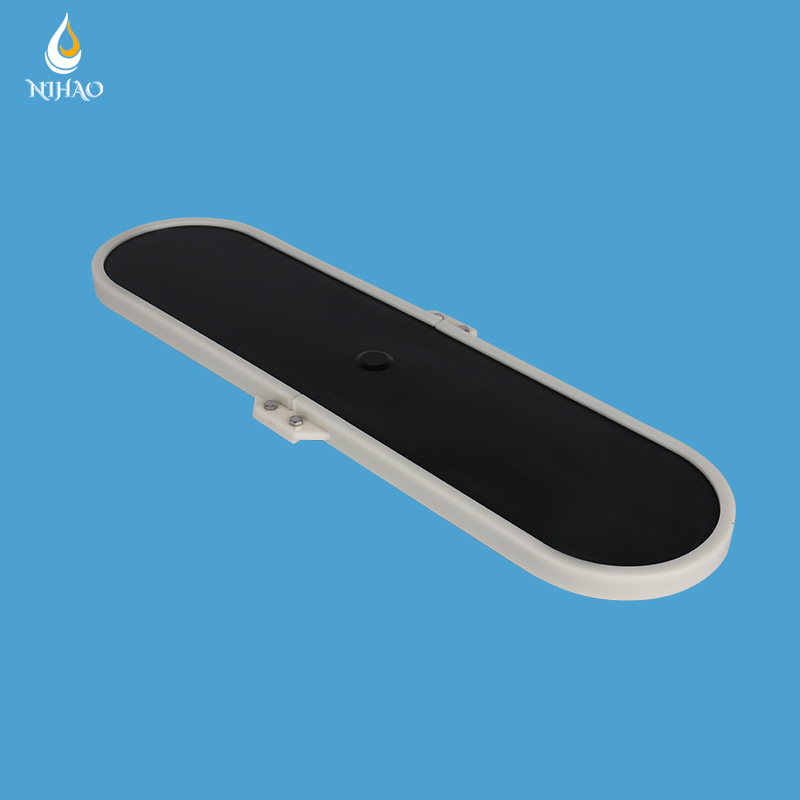
A plate diffuser consists of three main components:
When compressed air is supplied, the membrane stretches uniformly across the plate surface and releases bubbles through thousands of micro-perforations. Unlike a disc diffuser — which concentrates all bubble emission from a 200–300 mm circular footprint — a single plate diffuser can cover 300 × 600 mm, 300 × 1000 mm, or larger areas depending on the model.
The membrane is bonded directly to the aluminum support plate during manufacture. This bonding method prevents debonding under sustained air pressure cycling — one of the main failure modes in older plate diffuser designs that used mechanically clamped membranes.
Key distinction: Plate diffusers are the only diffuser format that combines fine bubble performance with high per-unit floor coverage. A single 300 × 600 mm plate diffuser covers the same floor area as approximately 4–6 disc diffusers, but requires only one air connection point.
Nihao produces both variants. They serve different functions and should not be used interchangeably.
| Fine Bubble Plate Diffuser | Coarse Bubble Plate Diffuser | |
|---|---|---|
| Membrane material | EPDM or silicone | EPDM or polyurethane |
| Bubble size | 1–3 mm | 3–25 mm |
| SOTE per meter depth | 6–8% | 3–4% |
| Primary function | Oxygen transfer | Mixing + oxygen transfer |
| Best application | Biological treatment (AS, MBBR, MBR) | Equalization, sludge holding, anoxic mixing |
| Fouling sensitivity | Moderate | Low |
| Operating pressure | 150–300 mbar above submergence head | 100–200 mbar above submergence head |
| Self-cleaning | Yes (dynamic orifice) | Yes (larger orifice, less critical) |
| Floor coverage per unit | High | High |
Rule of thumb: Use fine bubble plate diffusers wherever biological oxygen demand (BOD/COD removal, nitrification) is the treatment goal. Use coarse bubble plate diffusers in pre-aeration zones, equalization basins, and anoxic tanks where mixing is the primary requirement and oxygen transfer is secondary.
This is the question engineers ask most often. The answer depends on three variables: tank size, tank depth, and required floor coverage density.
| Parameter | Plate Diffuser | Disc Diffuser | Tube Diffuser |
|---|---|---|---|
| Floor coverage per unit | High (0.06–0.30 m²) | Low (0.03–0.07 m²) | Medium (0.04–0.10 m²) |
| Air connections per m² of floor | Low | High | Medium |
| SOTE (fine bubble, per meter depth) | 6–8% | 6–8% | 6–7% |
| Performance in deep tanks (>5 m) | Excellent | Excellent | Good |
| Performance in shallow tanks (3 m) | Moderate | Good | Good |
| Lateral pipe grid complexity | Simpler (fewer saddles) | Complex (many saddles) | Moderate |
| Membrane replacement | Full plate swap | Individual disc swap | Membrane sleeve swap |
| Unit cost | Higher per unit | Lower per unit | Low per unit |
| Total installed cost (large tank) | Lower (fewer units + connections) | Higher | Medium |
| Mixing intensity | Moderate-High | Low-Moderate | Low-Moderate |
The key insight: On a per-unit basis, plate diffusers cost more than disc diffusers. On a per-m² of floor coverage basis, they are often cheaper — because you install fewer units, drill fewer saddle connections, and lay shorter lateral piping.
For a 1,000 m² aeration tank at 60% floor coverage:
This difference matters significantly in large municipal plants where installation labor is a major project cost.
The classic application. Municipal AS tanks are typically rectangular, 4–7 m deep, and 500–5,000 m² in floor area. The combination of large floor area and deep water column plays directly to the plate diffuser’s strengths:
High-BOD industrial effluent requires sustained high oxygen demand — often 150–300% of typical municipal loads. Plate diffusers support this by delivering a high air volume per connection point, reducing the total number of fittings that must hold pressure under demanding duty cycles. The aluminum alloy support plate is also more resistant to chemical attack than ABS plastic under aggressive industrial wastewater conditions.
Deep shaft aeration (tank depth 8–20 m) is used in space-constrained urban installations where surface footprint is expensive. At these depths, fine bubble plate diffusers achieve SOTE values of 35–50% — significantly higher than the 20–30% typical for 5–6 m conventional tanks. The rigid aluminum plate maintains dimensional stability at high hydrostatic pressures that can distort lighter plastic-framed disc diffusers.
Many older municipal plants use coarse bubble pipe diffusers or mechanical surface aerators. When upgrading to fine bubble aeration, plate diffusers offer an advantage: their larger footprint means fewer units need to be installed in the existing pipe grid, reducing the scope of civil and piping modifications. Energy savings of 30–40% over coarse bubble systems are typical in retrofit scenarios.
SOTE for fine bubble plate diffusers follows the same fundamental physics as all fine bubble membrane systems — approximately 6–8% per meter of submergence in clean water. What differentiates plate diffusers in real-world process performance is the alpha factor (actual process water OTE divided by clean water OTE).
Alpha is influenced by:
| Submergence depth | Approximate SOTE (clean water) | Typical process alpha | Approximate field OTE |
|---|---|---|---|
| 3 m | 18–24% | 0.5–0.7 | 9–17% |
| 4.5 m | 27–36% | 0.5–0.7 | 14–25% |
| 6 m | 36–48% | 0.5–0.7 | 18–34% |
| 8 m | 48–64% | 0.5–0.7 | 24–45% |
This is why deep tanks are so energy-efficient with fine bubble diffusers: each additional meter of submergence adds roughly 6–8% more oxygen transfer for the same air volume. A 6 m tank transfers roughly twice the oxygen per cubic meter of air as a 3 m tank.
Aeration energy as share of total WWTP energy consumption: 50–70%. Selecting the right diffuser format and maximizing submergence depth are the two largest single levers available to reduce plant operating cost.
Plate diffusers are installed in a grid pattern on the tank floor, connected to lateral distribution pipes via threaded or flanged inlets. The aluminum support plate is anchored to the floor using stainless steel brackets. The membrane is factory-bonded and does not require field assembly.
Key installation considerations:
| Task | Frequency | Method |
|---|---|---|
| Visual inspection (bubble uniformity) | Monthly | Observation during operation |
| Dynamic Wet Pressure (DWP) check | Quarterly | Pressure gauge on blower outlet |
| Physical cleaning | 1–3 years | Drain tank, pressure wash membrane surface |
| Acid cleaning (scaling) | As needed | Citric acid or HCl solution soak |
| Membrane replacement | 5–10 years | Remove plate from bracket, swap membrane panel |
The aluminum alloy support plate is designed for the full service life of the installation — typically 15–20 years. Only the membrane requires periodic replacement, which reduces long-term maintenance cost compared to full-unit disc diffuser replacements.
Plate diffusers are not the right choice for every application:
Shallow tanks (3 m): The SOTE advantage of fine bubble aeration scales with depth. In very shallow tanks, the bubble residence time is too short to justify the higher cost of plate diffusers over tube diffusers or aeration hose.
Irregular or circular tank geometry: The rectangular plate format is optimized for rectangular tanks. In circular basins, oxidation ditches, or L-shaped tanks, the wasted floor area at the perimeter reduces coverage efficiency. Aeration hose or disc diffusers are better suited to non-rectangular geometries.
Very high-MLSS MBR systems (>10,000 mg/L): At extreme MLSS concentrations, the high viscosity of the mixed liquor creates significant resistance to bubble rise. In these conditions, the membrane scouring duty requires very high air flux per unit — which favors individual disc diffusers with check valves over large-area plate diffusers.
Small or modular plants (<100 m² tank area): The installed cost advantage of fewer connection points only materializes at scale. For small plants, the higher per-unit cost of plate diffusers compared to disc or tube diffusers is not offset by installation labor savings.
When specifying a plate diffuser, confirm these parameters with the manufacturer:
| Specification | Typical range | Why it matters |
|---|---|---|
| Plate dimensions | 300×300 mm to 600×1000 mm | Determines floor coverage per unit and grid layout |
| Membrane material | EPDM (standard) / Silicone (chemical/cold) | Fouling resistance, lifespan, bubble size |
| Support plate material | Aluminum alloy (deep/industrial) / ABS (standard) | Pressure resistance, chemical compatibility |
| Perforation density | 6,000–20,000 holes/m² | Bubble size and SOTE |
| Max air flux | 10–30 m³/hr per unit | Determines blower sizing |
| Operating pressure | 150–500 mbar above submergence | Blower selection |
| Max submergence | 8–12 m (aluminum) / 5–8 m (ABS) | Deep shaft compatibility |
Yes, specify plate diffusers if:
No, consider disc, tube, or aeration hose instead if:
Nihao’s plate diffuser range includes both fine bubble (EPDM/silicone membrane, aluminum alloy plate) and coarse bubble variants, available for intermittent and continuous operation. Suitable for medium to large municipal and industrial wastewater treatment plants



86-15267462807


86-15267462807
