


 English
 عربى
عربى
 Español


×
Password
Get password
Enter password to download relevant content.
Submit
 +86-15267462807
Direct answer: A tube settler increases the effective settling area of a clarifier by 2–4x without expanding the tank footprint, by dividing the flow into many shallow inclined passages where particles only need to fall a short distance before hitting a surface. The two key design parameters are the surface overflow rate (SOR) — how much flow per unit of tank plan area the system must handle — and the tube rise rate — the upward water velocity inside the tubes, which must stay below the settling velocity of the target particles. Get these two numbers right, and the rest of the design follows.
In a conventional open clarifier, a particle must fall the full depth of the tank — typically 3–5 m — before it reaches the sludge zone. Most fine particles (10–100 µm) settle at 0.1–2.0 m/h, which means long hydraulic retention times and large tank volumes.
Allen Hazen established in 1904 that the performance of a settling tank depends not on its depth or retention time, but entirely on its plan surface area relative to flow. A shallow tank with the same plan area as a deep tank removes exactly the same particles. This is the theoretical basis for tube settlers.
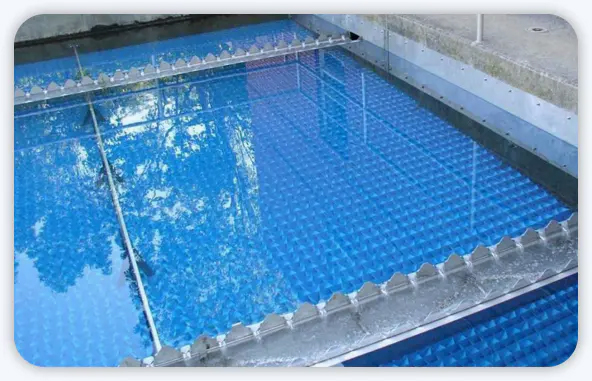
A tube settler module installed at 60° inclination divides the flow into dozens of inclined passages, each with a vertical depth of only 50–100 mm. A particle settling at 0.5 m/h only needs to travel 50–100 mm vertically before hitting the tube wall — instead of 3–5 m in the open tank. The result: the effective settling area of the clarifier multiplies by 2–4x.
The settled solids slide down the inclined tube wall (minimum 45°, standard 60°) under gravity, countercurrent to the rising water flow, and fall into the sludge collection zone below.
SOR is the volumetric flow rate divided by the plan area of the settling zone. It represents the upward water velocity in the open clarifier above and below the tube modules.
SOR (m/h) = Q (m³/h) / A (m²)
where Q = design flow rate, A = plan area of settling zone
SOR is also called hydraulic surface loading rate or overflow rate. It has units of m/h or m³/(m²·h) — both are equivalent and mean the same thing: the velocity at which the water surface rises if no settling occurred.
Design limits for tube settlers:
| Application | Recommended SOR | Maximum SOR |
|---|---|---|
| Drinking water (low turbidity) | 5–8 m/h | 10 m/h |
| Municipal wastewater secondary clarifier | 1.0–2.5 m/h | 3.5 m/h |
| Municipal wastewater with coagulation | 3–6 m/h | 7.5 m/h |
| Industrial wastewater (high SS) | 1.0–2.0 m/h | 3.0 m/h |
| Stormwater / high-turbidity events | 2–4 m/h | 6 m/h |
| DAF pre-treatment (after flocculation) | 4–8 m/h | 12 m/h |
Without tube settlers, conventional clarifiers typically operate at 1–3 m/h SOR. Adding tube modules allows the same tank to operate at 3–7 m/h — which is how tube settlers achieve the 2–4x capacity increase.
The rise rate is the upward water velocity inside the tube passages. This is different from the SOR — it accounts for the geometry of the tube itself.
For countercurrent-flow tubes inclined at angle θ from horizontal:
Rise rate (Vr) = SOR / (sin θ + L/d × cos θ)
where:
At standard 60° inclination with 600 mm tubes of 50 mm diameter:
The geometric factor (sin 60° + 600/50 × cos 60°) = 0.866 + 6.0 = 6.866
This means the effective settling area inside the tubes is approximately 6.9x the plan area — explaining why tube settlers multiply clarifier capacity by this factor.
Critical rise rate limits:
| Condition | Maximum Rise Rate |
|---|---|
| General design target | < 10 m/h |
| Fine particle removal (< 20 µm) | < 3 m/h |
| Coagulated floc | < 6 m/h |
| Laminar flow requirement (Re < 500) | Verify Reynolds number |
Tube settlers only function correctly under laminar flow conditions. Turbulent flow inside the tubes destroys the velocity gradient that allows particles to settle onto tube walls — it resuspends settled material and drastically reduces efficiency.
The Reynolds number inside the tube must stay well below the laminar-turbulent transition:
Re = (Vr × Dh) / ν
where:
Flow regime thresholds:
| Reynolds Number | Flow Regime | Tube Settler Performance |
|---|---|---|
| < 500 | Fully laminar | Excellent — design target |
| 500–2000 | Transitional laminar | Acceptable |
| 2000–2300 | Pre-turbulent | Marginal — avoid |
| > 2300 | Turbulent | Tube settler fails — do not operate |
Worked example:
Re = (0.00139 × 0.050) / (1.0 × 10⁻⁶) = 69.5
Well within laminar range. Most properly designed tube settler installations operate at Re = 50–200.
Temperature effect: At 10°C, water viscosity increases to 1.3 × 10⁻⁶ m²/s, which reduces Re by 23% for the same flow rate — actually improving laminar stability. Cold water is beneficial for tube settler hydraulics, though it slightly reduces particle settling velocity.
Design Adjustment: As a rule of thumb, settling velocity ($V_s$) decreases by approximately 2% for every 1°C drop in water temperature. In cold climates, the design SOR should be reduced by 20–30% compared to summer peaks to maintain the same effluent quality.
The Froude number assesses the stability of the flow regime — specifically whether density currents and short-circuiting will disrupt uniform flow distribution across the tube modules.
Fr = Vr / (g × Dh)^0.5
Design requirement: Fr > 10⁻⁵
Low Froude numbers indicate that density-driven currents (from temperature differentials or high suspended solids concentrations) can override the inertial flow and create short-circuit pathways through the tube bundle — some tubes carry too much flow, others too little.
In practice, Fr > 10⁻⁵ is easily met in normal tube settler designs, but it becomes critical in:
The standard inclination angle is 60° from horizontal. This is not arbitrary:
| Angle | Self-Cleaning | Settling Efficiency | Typical Use |
|---|---|---|---|
| 45° | Marginal | High | Rarely used — sludge sticking risk |
| 55° | Good | High | Some plate settler designs |
| 60° | Excellent | High | Standard — tube and plate settlers |
| 70° | Excellent | Moderate | Some specialty applications |
Standard tube modules are 600 mm or 1200 mm in length. Longer tubes provide more settling surface per unit of plan area but increase pressure drop and require more structural support.
| Tube Length | Geometric Factor (60°, 50 mm dia) | Effective Area Multiplier |
|---|---|---|
| 300 mm | ~3.9 | ~3.9x |
| 600 mm | ~6.9 | ~6.9x |
| 1000 mm | ~11.2 | ~11.2x |
| 1200 mm | ~13.3 | ~13.3x |
Longer tubes dramatically increase the effective settling area. However, above 1,000–1,200 mm, structural deflection under hydraulic load becomes a design concern, and access for cleaning is limited.
Common tube shapes and their hydraulic diameters:
| Cross-Section Shape | Internal Size | Hydraulic Diameter |
|---|---|---|
| Circular | 50 mm bore | 50 mm |
| Square | 50 × 50 mm | 50 mm |
| Hexagonal (honeycomb) | 25 mm flat-to-flat | 25 mm |
| Rectangular | 50 × 80 mm | 61.5 mm |
Smaller hydraulic diameter increases Re for the same velocity — it is therefore not always advantageous to use very fine-channel media in high-flow applications. Hexagonal honeycomb media with 25 mm channels is most efficient in low-velocity, fine-particle applications (drinking water polishing). Square or rectangular tubes are more common in municipal and industrial wastewater where higher flow velocities and easier cleaning access are priorities.
Required area = Q / SOR = 208 / 5 = 41.6 m²
The existing 50 m² tank is sufficient. Tube settlers must cover at least 41.6 m² of plan area.
Geometric factor = sin 60° + (600/50) × cos 60°
= 0.866 + 12 × 0.500
= 0.866 + 6.0
= 6.866
Rise rate inside tubes = SOR / geometric factor = 5.0 / 6.866 = 0.728 m/h = 0.000202 m/s
Re = (0.000202 × 0.050) / (1.0 × 10⁻⁶) = 10.1
Far below 500 — excellent laminar flow confirmed.
Fr = 0.000202 / (9.81 × 0.050)^0.5 = 0.000202 / 0.700 = 2.9 × 10⁻⁴
Greater than 10⁻⁵ — stable flow, no density current risk.
Cross-sectional area of one 50 mm square tube = 0.050 × 0.050 = 0.0025 m²
Volume of one tube = 0.0025 × 0.600 = 0.00150 m³
Flow per tube = Rise rate × tube cross-section = 0.000202 × 0.0025 = 5.05 × 10⁻⁷ m³/s
Detention time = Volume / Flow = 0.00150 / (5.05 × 10⁻⁷) = 2,970 seconds = 49.5 minutes
Design guideline: detention time inside tubes should be < 20 minutes for plate settlers and < 10 minutes for tube settlers. This design at 49.5 minutes is conservative — indicating the system is operating well below the hydraulic limit.
Practical Note on Installation: > Because tube modules are lightweight (especially PP), they can become buoyant or shift during hydraulic surges or cleaning. Always specify 304/316 stainless steel anti-flotation bars or a dedicated clamping system across the top of the modules to ensure they remain submerged and aligned.
Material Selection:
PP (Polypropylene): Food-grade, superior chemical resistance, and better performance in high-temperature industrial wastewater.
PVC (Polyvinyl Chloride): High structural rigidity and UV resistance, often preferred for large-scale outdoor municipal plants.
At standard module dimensions of 1.0 m × 1.0 m plan footprint:
Number of modules required = 41.6 m² / 1.0 m² = 42 modules minimum
Add 10–15% safety margin: specify 48 modules covering 48 m² of the 50 m² settling zone.
Two additional hydraulic requirements are often overlooked:
Clear water zone above tube modules: Minimum 300 mm of open water between the top of the tube modules and the effluent launder. This zone allows flow to redistribute horizontally after exiting the tubes, preventing short-circuiting directly from tube exit to effluent weir.
Launder loading rate: The clarified water removal rate at the effluent launder should not exceed 15 m³/h per meter of equivalent launder length. Exceeding this creates high-velocity zones that draw flow preferentially from nearby tube modules, reducing effective utilization of the full module array.
Sludge zone below tube modules: Minimum 1.0–1.5 m clear height between the bottom of the tube module frame and the sludge collection hopper. This prevents re-entrainment of settled sludge into the upward flow entering the tubes — a common cause of poor performance in retrofit installations where tube modules are hung too low.
| Mistake | Consequence | Fix |
|---|---|---|
| SOR calculated on total tank area, not settling zone area | Underestimated loading — tubes underpowered | Subtract inlet zone, sludge hopper, and dead zones from plan area |
| Rise rate not verified against particle settling velocity | Fine particles not removed — effluent TSS high | Calculate target particle Vs; ensure rise rate < Vs |
| Insufficient clear water zone above modules | Short-circuiting — effluent quality worse than expected | Maintain minimum 300 mm above tube tops |
| Tube modules installed too low — sludge re-entrainment | Settled sludge stirred back into the flow | Maintain 1.0–1.5 m between module bottom and hopper |
| Ignoring temperature effect on viscosity | Winter performance degradation underestimated | Recalculate Re and Vs at minimum design temperature |
| Angle < 60° specified to increase settling area | Sludge accumulates, tubes foul and blind off | Never specify below 55°; 60° is the safe minimum |
| Launder loading rate exceeded | Uneven flow — outer modules starved | Size launder for ≤ 15 m³/h per meter of weir length |
| Neglecting sludge accumulation | High-SS sludge can bridge and collapse the modules | Implement a regular water-jet cleaning schedule and ensure sludge scrapers are functional |
Tube settlers and plate settlers share the same Hazen principle but differ in hydraulic behavior:
| Parameter | Tube Settler | Plate (Lamella) Settler |
|---|---|---|
| Channel hydraulic diameter | 25–80 mm | 50–150 mm (gap between plates) |
| Reynolds number (typical) | 10–200 | 50–500 |
| Effective area multiplier | 5–13x | 3–8x |
| Sludge sliding behavior | Confined — slides within tube | Open — slides on plate surface |
| Fouling risk | Higher (enclosed geometry) | Lower (open surfaces) |
| Cleaning access | Difficult — must remove modules | Easier — spray cleaning in place |
| Structural support | Self-supporting modules | Requires frame and spacing |
| Best application | Municipal WW, drinking water | Industrial WW, high-sludge loads |
The enclosed geometry of tubes gives a lower Reynolds number (better laminar stability) for the same hydraulic diameter — which is why tubes outperform plates in low-flow, fine-particle applications. But the same enclosure makes cleaning harder, which is why plate settlers are preferred in applications with heavy or sticky sludge that requires regular cleaning.
| Parameter | Target | Limit |
|---|---|---|
| Surface Overflow Rate — municipal WW | 1.5–2.5 m/h | < 3.5 m/h |
| Surface Overflow Rate — drinking water | 5–8 m/h | < 10 m/h |
| Rise rate inside tubes | < 5 m/h | < 10 m/h |
| Reynolds number inside tubes | < 200 | < 500 |
| Froude number | > 10⁻⁴ | > 10⁻⁵ |
| Tube inclination angle | 60° | > 55° |
| Clear water zone above modules | 400–500 mm | > 300 mm |
| Sludge zone below modules | 1.2–1.5 m | > 1.0 m |
| Detention time inside tubes | 5–15 min | < 20 min |
| Launder loading rate | < 10 m³/h·m | < 15 m³/h·m |
Nihao's tube settler modules feature reinforced tongue-and-groove joints to prevent module separation. They are available in 600 mm and 1200 mm lengths, using high-precision CNC-formed 50mm square-section PVC or PP. For projects requiring high-load capacity, we provide custom thickness options to prevent mid-span deflection. Contact nihaowater for module sizing and layout drawings.



86-15267462807


86-15267462807
