


 English
 عربى
عربى
 Español


×
Password
Get password
Enter password to download relevant content.
Submit
 +86-15267462807
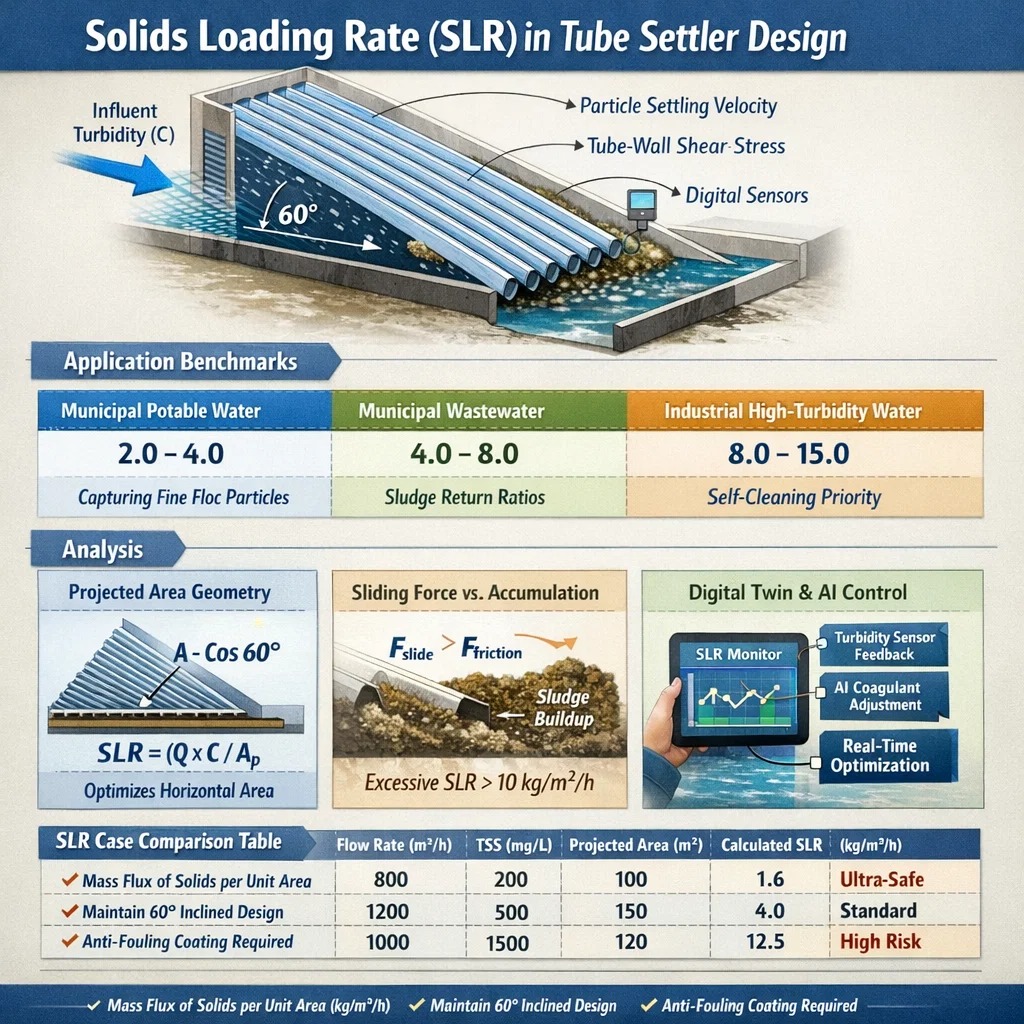
The Solids Loading Rate (SLR) in tube settler design is a physical quantity that measures the mass flux of suspended solids applied per unit of horizontal projected area. Its core significance lies in defining the dynamic equilibrium between particle settling velocity and tube-wall shear stress. Unlike the Surface Overflow Rate (SOR), which focuses on hydraulic retention, the SLR is the primary determinant for preventing tube occlusion and density current failures.
In a digitized design environment, SLR is no longer treated as a static value but as a dynamic function of influent turbidity.
| Application | Typical SLR Range (kg/m2/h) | Critical Design Constraint |
|---|---|---|
| Municipal Potable Water | 2.0 – 4.0 | Focuses on capturing fine flocculent particles. |
| Municipal Wastewater (Secondary) | 4.0 – 8.0 | Must account for sludge return ratios on concentration. |
| Industrial High-Turbidity Water | 8.0 – 15.0 | Prioritizes the self-cleaning capability of the tubes. |
While many engineering manuals simplify the calculation to SLR = (Q * C) / A, a high-depth digital analysis requires focusing on these three dimensions:
Where:
Q = Flow rate (m³/h)
C = Solids concentration (kg/m³)
A_settler = Effective tube settling area (m²)
Tube settlers do not increase tank volume; they maximize the horizontal projected area (Ap) via a 60 degree inclination. The variable A in the formula must represent the sum of the horizontal projections of all tube openings. If the SLR is too high, the “sludge film” thickness during sliding will exceed 15% to 20% of the tube diameter. This triggers a localized surge in the Reynolds Number (Re), transitioning flow from laminar to turbulent and causing a catastrophic drop in settling efficiency.
Self-cleaning in a tube depends on the gravitational component:
F_slide = m * g * sin(theta)
When SLR exceeds 10 kg/m2/h, the friction (F_friction) generated by high-viscosity industrial sludge may overcome the sliding force. Digital monitoring systems utilize differential pressure sensors at the tube base; if SLR consistently exceeds limits, the resulting sludge buildup forces water through a smaller cross-section, causing “breakthrough” or scouring of settled solids.
In Water 4.0 architectures, SLR is integrated into Digital Twin models. By utilizing real-time influent turbidity (C) feedback, AI algorithms automatically adjust upstream coagulant dosing. This modifies floc density (rho_p) to maintain “slidability” even when the system operates near the upper SLR limit of 15 kg/m2/h.
The following data demonstrates that under high-load conditions, simply increasing area is not the optimal solution; concentration management is key.
| Flow Rate (m3/h) | Influent TSS (mg/L) | Projected Area (m2) | Calculated SLR | Risk Assessment |
|---|---|---|---|---|
| 800 | 200 | 100 | 1.6 | Ultra-Safe: Typical for potable water polishing. |
| 1200 | 500 | 150 | 4.0 | Standard: Median design for municipal projects. |
| 1000 | 1500 | 120 | 12.5 | High Risk: Requires automated high-pressure backwash. |



86-15267462807


86-15267462807
