


 English
 عربى
عربى
 Español


×
Password
Get password
Enter password to download relevant content.
Submit
 +86-15267462807
Lamella clarifiers use flat, inclined plates, typically installed at angles of 55–65° with 50–75 mm spacing.
In most industrial wastewater applications, this open plate geometry allows lamella clarifiers to handle significantly higher solids loading rates than tube settlers.
Tube settlers rely on enclosed tubes—commonly 50 mm in diameter—inclined at 55–60°, which are more susceptible to fouling under high solids conditions.
While lamella systems may have slightly higher initial capital cost in some configurations, they typically achieve footprint reductions of up to 80–90% and require lower long-term maintenance due to improved solids discharge.
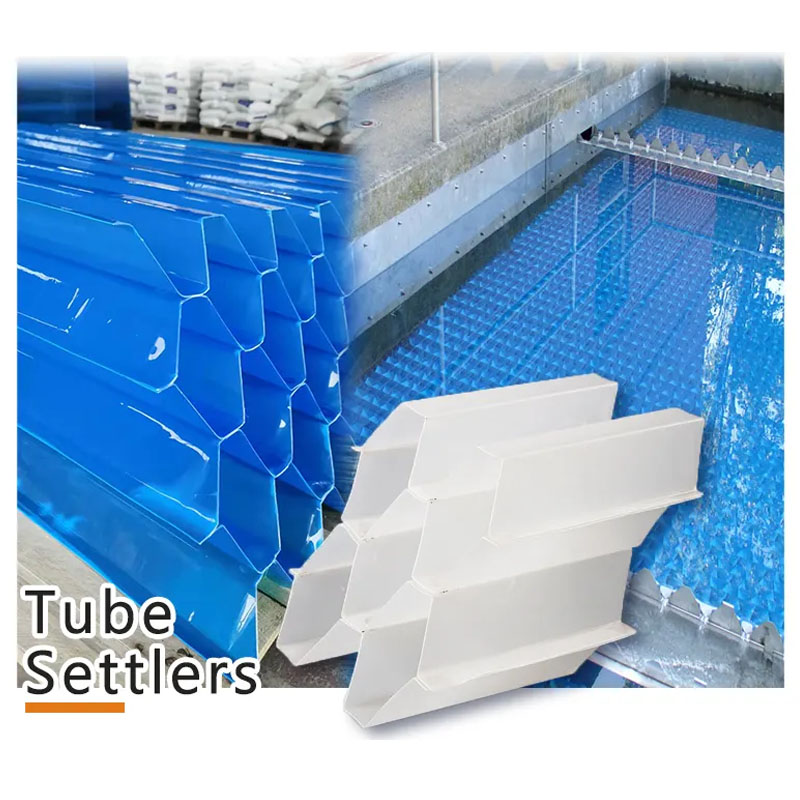
Traditional clarifiers rely on horizontal settling where particles must travel the entire tank depth. Inclined plate/tube settlers reduce settling distance by 85-90% through a simple principle: particles settle perpendicular to flow, so tilting the surface dramatically shortens their journey.
The math behind it: According to Stokes’ Law, settling velocity (Vs) = (g × d² × (ρp - ρf)) / (18 × μ)
Where a 10-micron particle settles at approximately 0.00088 m/s in water at 20°C. In a conventional clarifier with 4m depth, this particle needs 75 minutes to settle. With inclined plates at 60° reducing effective settling distance to 0.05m, settling time drops to just 57 seconds.
Tube settlers consist of PVC or polypropylene modules containing multiple parallel tubes. Critical dimensions:
Reynolds number in tubes: Re = (V × D) / ν
For typical flow velocity of 0.15 m/s in 50mm tubes: Re ≈ 7,500 (turbulent flow)
This creates a paradox: we need laminar flow (Re < 2,000) for optimal settling, but actual operation is often transitional or turbulent. This is why effective settling occurs in the boundary layer near tube walls, not in the core flow.
Actual vs theoretical efficiency: Laboratory tests show 85-95% removal of particles >50 microns, but field installations achieve 70-85% due to:
Cleaning frequency correlates directly with solids loading:
| Influent SS (mg/L) | Cleaning Interval | Typical Method |
|---|---|---|
| 50-100 | 6-12 months | High-pressure spray |
| 100-300 | 3-6 months | Chemical cleaning + spray |
| 300-500 | 1-3 months | Module removal required |
| >500 | Not recommended | Frequent clogging |
Chemical cleaning protocol: 2-3% sodium hydroxide solution at 40-50°C for 4-6 hours removes biological films. This requires system downtime and adds $3,000-8,000/year in operating costs for a 100 m³/h system.
Lamella systems use parallel inclined plates with specific engineering considerations:
Plate spacing calculation:
Optimal spacing (S) = √(8 × Q × L × sinθ) / (Vs × W × N)
Where:
For a 200 m³/h system treating water with 30-micron particles (Vs = 0.008 m/s):
Lamellas excel because of continuous solids discharge. The steeper angle (60-65° vs 55-60° for tubes) creates a critical difference:
Sliding friction analysis:
Quantified performance:
| Parameter | Tube Settlers | Lamella Clarifiers |
|---|---|---|
| Max influent SS | 300 mg/L | 1,500 mg/L |
| Surface loading rate | 1.5-2.5 m/h | 3-6 m/h |
| Solids flux capacity | 5-8 kg/m²·h | 15-25 kg/m²·h |
| TSS removal efficiency | 70-85% | 80-92% |
| Footprint reduction | 75-85% | 85-92% |
Velocity profile between lamella plates:
At 50mm spacing with 0.2 m/s average velocity:
This creates a dual-zone system: rapid transport in the center, quiescent settling near plates. CFD modeling shows this generates 35-40% more effective settling area compared to tube settlers where the circular geometry creates dead zones.
Tube settler system:
Lamella clarifier system:
Initial cost difference: +2.7% (not the often-quoted 20-30%)
Tube settlers:
Lamella clarifiers:
True lifecycle comparison:
Use tube settlers when:
Choose lamella clarifiers when:
Temperature impact (critical but often ignored):
| Temperature | Kinematic Viscosity | Settling Velocity Impact | System Performance |
|---|---|---|---|
| 5°C | 1.52 × 10⁻⁶ m²/s | 68% of 20°C rate | Tube: -25% efficiency Lamella: -15% efficiency |
| 20°C | 1.00 × 10⁻⁶ m²/s | Baseline (100%) | Tube: baseline Lamella: baseline |
| 35°C | 0.72 × 10⁻⁶ m²/s | 139% of 20°C rate | Tube: +18% efficiency Lamella: +22% efficiency |
Why lamella performs better in cold: The open channel design maintains better flow distribution even when viscosity increases. Tube settlers develop more pronounced dead zones and short-circuiting at low temperatures.
Recent developments combine both technologies:
Tube-lamella hybrid configuration:
For systems treating <150 m³/h with clean water applications: tube settlers deliver adequate performance at lowest initial cost.
For systems treating >150 m³/h or any high-solids application: lamella clarifiers provide superior lifecycle value despite 3-5% higher initial investment.
The breakeven calculation:
If space savings are valued at $150/m² and operating cost reduction at $4,000/year, lamella systems break even within 18-24 months for industrial applications.



86-15267462807


86-15267462807
