


 English
 عربى
عربى
 Español


×
Password
Get password
Enter password to download relevant content.
Submit
 +86-15267462807
Wastewater treatment media are materials or engineered structures placed inside treatment units to support biological growth, improve solids separation, filter suspended particles, adsorb dissolved contaminants, exchange ions, or separate water through membranes.
However, the term “treatment media” covers several fundamentally different technologies. MBBR carriers, tube settlers, activated carbon, sand filters, ion exchange resins, and MBR membranes should not be treated as interchangeable products. Each works through a different mechanism and must be selected according to the wastewater characteristics, treatment objective, reactor configuration, operating conditions, and required effluent quality.
At Hangzhou NIHAO Environmental Tech Co., Ltd., we work with wastewater treatment contractors, plant owners, equipment manufacturers, distributors, and engineering companies. Based on this industry perspective, this guide explains the main types of wastewater treatment media and the information buyers should evaluate before placing an order.
| Media Category | Typical Products | Primary Function | Common Applications |
|---|---|---|---|
| Biological carrier media | MBBR media, IFAS media, fixed biofilm media, bio blocks | Provides protected surface for microorganisms | COD, BOD and nitrogen removal |
| Settling media | Tube settlers, lamella modules, inclined plate packs | Increases effective settling area | Clarifiers and sedimentation tanks |
| Granular filter media | Sand, anthracite, garnet, gravel, zeolite | Captures suspended particles in a filter bed | Tertiary filtration and polishing |
| Adsorption media | Activated carbon, activated alumina, iron-based media | Adsorbs dissolved contaminants | Color, odor and specific contaminant removal |
| Ion exchange media | Cation, anion and selective resins | Exchanges dissolved ions | Hardness, nitrate, ammonium and metal removal |
| Reactive media | Zero-valent iron, sulfur media, phosphorus-removal media | Removes pollutants through chemical or biological reactions | Denitrification and phosphorus removal |
| Membrane media | MF, UF, MBR, NF and RO membranes | Separates contaminants through a membrane barrier | High-quality effluent and water reuse |
Moving bed biofilm reactor media, commonly called MBBR media, are engineered plastic carriers that move freely inside an aerated or mechanically mixed bioreactor. Microorganisms attach to the protected surfaces of the carriers and form an active biofilm.
MBBR media are commonly used for reducing organic load, supporting nitrification, assisting denitrification, and increasing biological treatment capacity without constructing a significantly larger tank. They are also used in integrated fixed-film activated sludge systems, known as IFAS, where suspended activated sludge and attached biofilm operate in the same reactor.
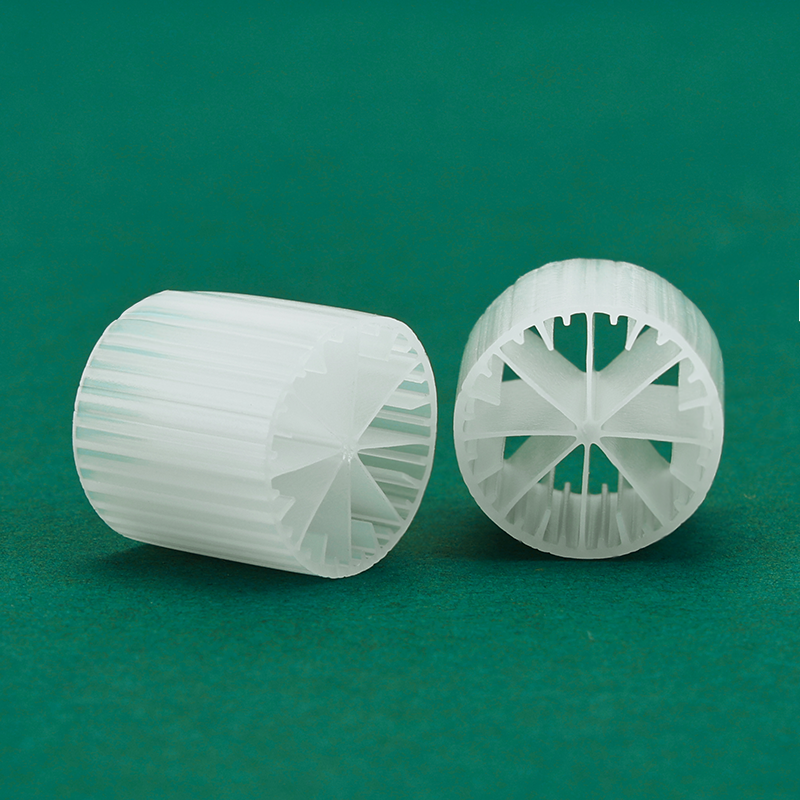
A higher published surface-area figure does not automatically mean better performance. Engineering buyers should request the definition of the stated area, supporting test methods, dimensional tolerances, material data, bulk quantity per cubic meter, and project references under comparable wastewater conditions.
Fixed biofilm media remain stationary inside a reactor, trickling filter, submerged aerated filter, anaerobic filter, or biological odor-control system. Common forms include structured sheet media, honeycomb blocks, cross-flow modules, vertical-flow media, random plastic packing, bio balls and porous blocks.
Unlike moving carriers, fixed media require wastewater and air to pass through or around a stationary structure. Their performance therefore depends heavily on hydraulic distribution, air distribution, void space, surface accessibility and resistance to clogging.
For wastewater containing high levels of fibers, grease, precipitated solids or biological sludge, buyers should give particular attention to channel width and clogging risk. A media structure with a very high nominal surface area may perform poorly if solids rapidly block its usable passages.
Tube settler media are not biological treatment carriers. They are clarification media used to improve gravity separation. Their inclined channels reduce the vertical distance a particle must settle before reaching a surface. Settled solids then move downward while clarified water travels upward through the module.

Tube settlers are commonly installed in municipal and industrial clarifiers, drinking-water sedimentation units, chemical precipitation tanks, secondary clarifiers and plant-upgrade projects. They can increase the effective settling area within an existing tank, but they cannot compensate for poor coagulation, unsuitable hydraulic loading or ineffective sludge removal.
Buyers should not select tube settlers only by price per cubic meter. Thin sheets, insufficient welding, inconsistent module dimensions or inadequate support design can cause deformation, collapsed channels and uneven flow distribution.
Granular filter media remove suspended particles as water passes through a packed bed. Common materials include silica sand, anthracite, garnet, gravel, zeolite and ceramic granules. Sand, activated carbon and garnet are among the media types evaluated for municipal water-treatment use under relevant certification programs.
Granular media may be arranged as a single-media, dual-media or multimedia filter. A typical multimedia arrangement may use coarse anthracite above finer sand, with dense garnet and supporting gravel below. The exact configuration depends on particle size distribution, filtration rate, required effluent turbidity and backwashing design.
Granular filtration is generally used for solids polishing. It should not be assumed to remove every dissolved pollutant. When dissolved organics, metals, nutrients or salts are the main concern, adsorption, ion exchange, reactive media or membrane processes may be required.
Adsorption media capture contaminants on their internal or external surfaces. Granular activated carbon is widely used for dissolved organic compounds, color, odor and polishing applications. Other products include powdered activated carbon, activated alumina, zeolite, iron oxide, iron hydroxide and specialized adsorbents.
The suitability of an adsorbent depends on the target contaminant, concentration, pH, competing ions, organic matter, contact time and regeneration or replacement strategy.
Buyers should be cautious about a single “adsorption capacity” value without test conditions. Capacity measured using a concentrated laboratory solution may not represent performance in complex industrial wastewater.
Ion exchange media are synthetic or mineral materials that exchange selected ions with ions in water. Common categories include strong-acid cation resin, weak-acid cation resin, strong-base anion resin, weak-base anion resin, mixed-bed resin and contaminant-selective resin.
Applications may include hardness reduction, demineralization, nitrate removal, ammonium removal and recovery of selected metals. Ion exchange is usually more sensitive to influent composition than basic solids filtration. Suspended solids, oil, oxidants and organic fouling can reduce resin performance.
Procurement specifications should identify resin type, ionic form, particle-size range, exchange capacity, moisture content, operating pH, temperature limit, pressure-drop data and regeneration requirements. Buyers must also evaluate chemical consumption and the management of regeneration waste.
Reactive media remove pollutants through chemical reaction, precipitation, oxidation-reduction or biologically assisted conversion. Examples include zero-valent iron, sulfur-based denitrification media, iron-carbon media, limestone and phosphorus-binding media.
Unlike a conventional mechanical filter, reactive media are gradually consumed, coated or exhausted. Their service life depends on influent chemistry, contaminant load, particle size, hydraulic contact and reaction by-products.
Before procurement, engineers should conduct bench or pilot testing whenever wastewater chemistry is complex. The supplier should clearly state reaction conditions, expected media consumption, possible pH changes, head-loss development and disposal requirements.
Membrane processes use a selective barrier to separate suspended solids, microorganisms, colloids or dissolved substances. Common categories include microfiltration, ultrafiltration, membrane bioreactor membranes, nanofiltration and reverse osmosis.
In an MBR system, biological treatment is combined with membrane separation. The membrane replaces or supplements conventional clarification and can produce low-turbidity effluent suitable for advanced treatment or reuse, subject to the complete process design.
MBBR and MBR should not be confused. MBBR uses carriers to retain attached biomass, while MBR uses membranes to physically separate treated water from mixed liquor. Some projects may combine biological carriers and membrane separation, but the two media perform different functions.
A credible supplier should not recommend media based only on the name of the wastewater industry. Two food-processing factories, for example, may have very different flow rates, organic loads, temperatures, grease levels and discharge requirements.
Before requesting a quotation, buyers should prepare the following information:
| Project Requirement | Media Commonly Considered | Critical Verification Point |
|---|---|---|
| Increase biological treatment capacity in an existing aeration tank | MBBR or IFAS carrier media | Organic and nitrogen loading, mixing, aeration and retention screens |
| Improve solids settling in an existing clarifier | Tube settler or lamella media | Hydraulic loading, solids characteristics and sludge removal |
| Reduce residual suspended solids | Sand or multimedia filtration | Particle loading, filtration rate and backwash capacity |
| Remove dissolved organic compounds or odor | Activated carbon or specialized adsorbent | Contact time and adsorption testing with actual water |
| Remove a specific dissolved ion | Selective ion exchange or reactive media | Competing ions, regeneration and waste disposal |
| Produce consistently low-turbidity effluent | MBR, MF or UF membrane | Pretreatment, flux, fouling control and cleaning strategy |
| Reduce dissolved salts for reuse | NF or RO membrane after suitable pretreatment | Scaling, concentrate disposal and recovery rate |
For international procurement, product appearance is only the first level of evaluation. Buyers should also review the supplier’s engineering understanding, manufacturing consistency, documentation and after-sales capability.
For engineered media such as MBBR carriers and tube settlers, small differences in dimensions, material consistency and module fabrication can affect hydraulic behavior, biofilm retention, installation and long-term durability. Procurement decisions should therefore consider total lifecycle suitability rather than purchase price alone.
Hangzhou NIHAO Environmental Tech Co., Ltd. provides wastewater treatment products and solutions for international engineering and procurement projects. Our principal product areas include MBBR biofilter media, tube settler media, biofilter media, MBR membranes, aeration components and related wastewater treatment equipment.
Our role is not simply to assign a product model from a catalog. For a responsible recommendation, we first need to understand the influent characteristics, process objective, tank configuration, operating environment and required discharge quality.
Where laboratory or pilot validation is necessary, it should be completed before a full-scale purchase. Final process sizing and performance guarantees must be based on project-specific engineering calculations, representative wastewater data and mutually agreed design conditions.
No. MBBR carriers and fixed biofilm products are biological media because they support attached microorganisms. Tube settlers are clarification media, while diffusers are aeration components rather than treatment media.
No. Tube settlers improve solids separation but do not replace biological COD, BOD or nitrogen removal. They are normally installed in clarification or sedimentation stages.
No. Usable protected area, carrier movement, biofilm thickness, oxygen transfer, loading conditions and reactor design are more important than an isolated surface-area number.
Normally not. These pollutants may require a treatment train combining biological media, clarification, filtration, adsorption, chemical treatment, ion exchange and membranes.
At minimum, provide the wastewater source, daily and hourly flow, influent analysis, required effluent, process diagram, tank dimensions, operating temperature and project objective. More complete data allow a more reliable technical recommendation.
Wastewater treatment media should be classified by treatment mechanism rather than appearance or material alone. Biological carriers support microorganisms, tube settlers improve clarification, granular filters capture suspended matter, adsorbents retain dissolved contaminants, ion exchange media remove selected ions, reactive media create chemical or biological reactions, and membranes provide a physical separation barrier.
For engineering buyers, the correct question is not simply, “Which wastewater treatment media are available?” The more useful question is, “Which media matches the pollutant, process stage, hydraulic conditions, operating capability and required effluent quality of this project?”
Hangzhou NIHAO welcomes technical discussions with wastewater treatment contractors, plant owners, distributors and equipment manufacturers. Providing accurate project data at the inquiry stage helps both parties develop a more practical and verifiable media-selection proposal.
Technical note: The information above is intended as a general procurement and process-selection guide. It does not replace project-specific process design, pilot testing, local regulatory review or engineering approval.



86-15267462807


86-15267462807
