Home / Technology / Understanding TSS in Wastewater: From Lab Analysis to Environmental Impact

Understanding TSS in Wastewater: From Lab Analysis to Environmental Impact

By: Kate Chen
Email: [email protected]
Date: Mar 11th, 2026

In the world of water treatment, Total Suspended Solids (TSS) stands as one of the most critical benchmarks for measuring water quality and treatment plant performance. Whether you are managing a municipal facility or an industrial pretreatment system, understanding the “what, why, and how” of TSS is essential for regulatory compliance and environmental protection.

What is TSS?

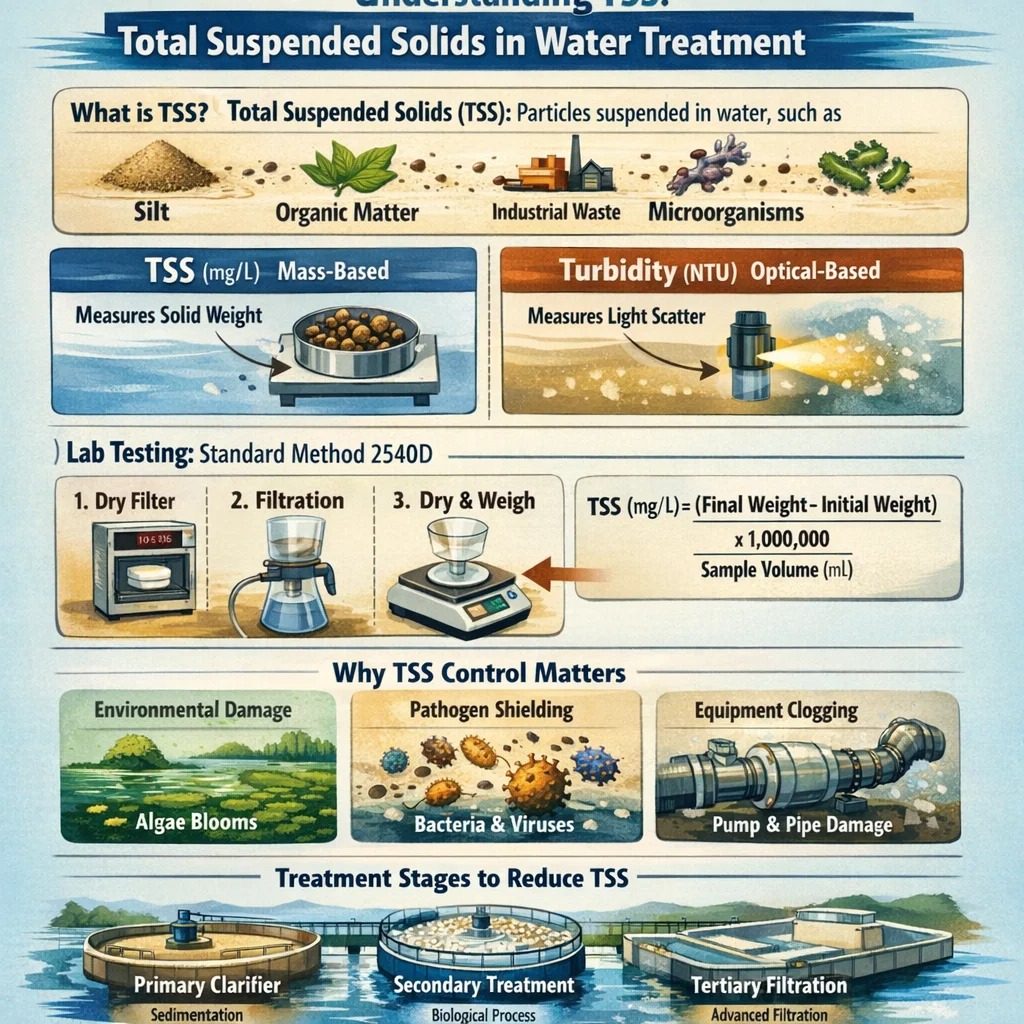
Total Suspended Solids (TSS) refers to the dry weight of particles trapped by a filter. Unlike dissolved solids, these particles are large enough to be seen or remain suspended in the water column due to turbulence. Common components of TSS include organic matter, silt, industrial byproducts, and microorganisms.

The Critical Difference: TSS vs. Turbidity

While often used interchangeably in casual conversation, these two metrics are fundamentally different:

  • TSS (Mass-based): This is a direct physical measurement of the actual weight of the solids. It is measured in milligrams per liter (mg/L).
  • Turbidity (Optical-based): This is an indirect measurement of how light scatters when hitting particles in the water. It is measured in Nephelometric Turbidity Units (NTU) using a light sensor.

While Turbidity provides instant results for real-time monitoring, TSS remains the legal “gold standard” for discharge permits because it quantifies the physical load being released into the environment.


Laboratory Method: The Standard Procedure

To ensure accuracy, laboratories follow a rigorous process known as Standard Method 2540D. The process relies on a precise mass-balance approach:

  1. Preparation: A glass-fiber filter is dried in an oven at 103-105 degrees Celsius, cooled in a desiccator, and weighed to find the Initial Weight.
  2. Filtration: A measured volume of the wastewater sample is pulled through the filter using a vacuum pump.
  3. Drying: The filter and the trapped solids are dried again at 103-105 degrees Celsius until all water has evaporated.
  4. Final Weighing: The dried filter is cooled and weighed again to find the Final Weight.

The Calculation Formula:
TSS (mg/L) = [(Final Weight in grams - Initial Weight in grams) x 1,000,000] / Sample Volume in milliliters


Why Removing TSS is Vital

High levels of TSS in effluent can lead to severe environmental and operational consequences:

  • Environmental Degradation: High TSS levels block sunlight in natural water bodies, stopping photosynthesis and “smothering” aquatic habitats.
  • Pathogen Shielding: Bacteria and viruses often attach to suspended solids. If TSS is high, these particles can “shield” microbes from UV light during disinfection, leading to unsafe water.
  • Equipment Damage: Excessive solids can clog membranes, wear down pump impellers, and lead to sludge buildup in pipes.

Treatment Strategies

Modern wastewater plants use a multi-stage “barrier” approach to reduce TSS:

  • Primary Treatment: Gravity clarifiers allow heavy solids to settle to the bottom.
  • Secondary Treatment: Biological processes (like activated sludge) turn dissolved waste into heavy biological “flocs” that can be settled out.
  • Tertiary Treatment: Advanced sand filtration, cloth media filters, or Coagulation/Flocculation chemicals are used to polish the water, often bringing TSS levels below 5-10 mg/L.

Conclusion

Monitoring TSS is more than just a regulatory hurdle; it is a window into the health of the entire treatment process. By balancing real-time Turbidity data with precise TSS laboratory analysis, water professionals can ensure that our discharge is clean, clear, and compliant.

Contact Us

*We respect your confidentiality and all information are protected.

×
Password
Get password
Enter password to download relevant content.
Submit
submit
Please send us a message