


 English
 عربى
عربى
 Español


×
Password
Get password
Enter password to download relevant content.
Submit
 +86-15267462807
Direct answer: Sludge bulking is when activated sludge fails to settle properly in the secondary clarifier, causing solids carryover into the effluent. Over 90% of cases are caused by filamentous bacteria overgrowth. The remaining cases involve non-filamentous mechanisms: viscous bulking from exopolymer overproduction and zoogloeal bulking from specific organic acids. The root trigger is almost always an operational imbalance — low dissolved oxygen, low F/M ratio, nutrient deficiency, or temperature shock — not a random biological event.
Sludge bulking is a settling failure in the activated sludge process. Instead of compacting cleanly at the bottom of the secondary clarifier, the sludge forms a voluminous, slow-settling mass that rises toward the effluent weir.
The standard diagnostic measure is the Sludge Volume Index (SVI):
SVI (mL/g) = Volume of settled sludge after 30 min (mL/L) / MLSS (mg/L) x 1000
| SVI Value | Interpretation |
|---|---|
| < 70 mL/g | Over-compacted — pin floc, poor settleability, turbid effluent |
| 70–150 mL/g | Normal — good settling, healthy floc structure |
| 150–250 mL/g | Bulking — poor settling, rising sludge blanket |
| > 250 mL/g | Severe bulking — clarifier overflow risk, TSS violation |
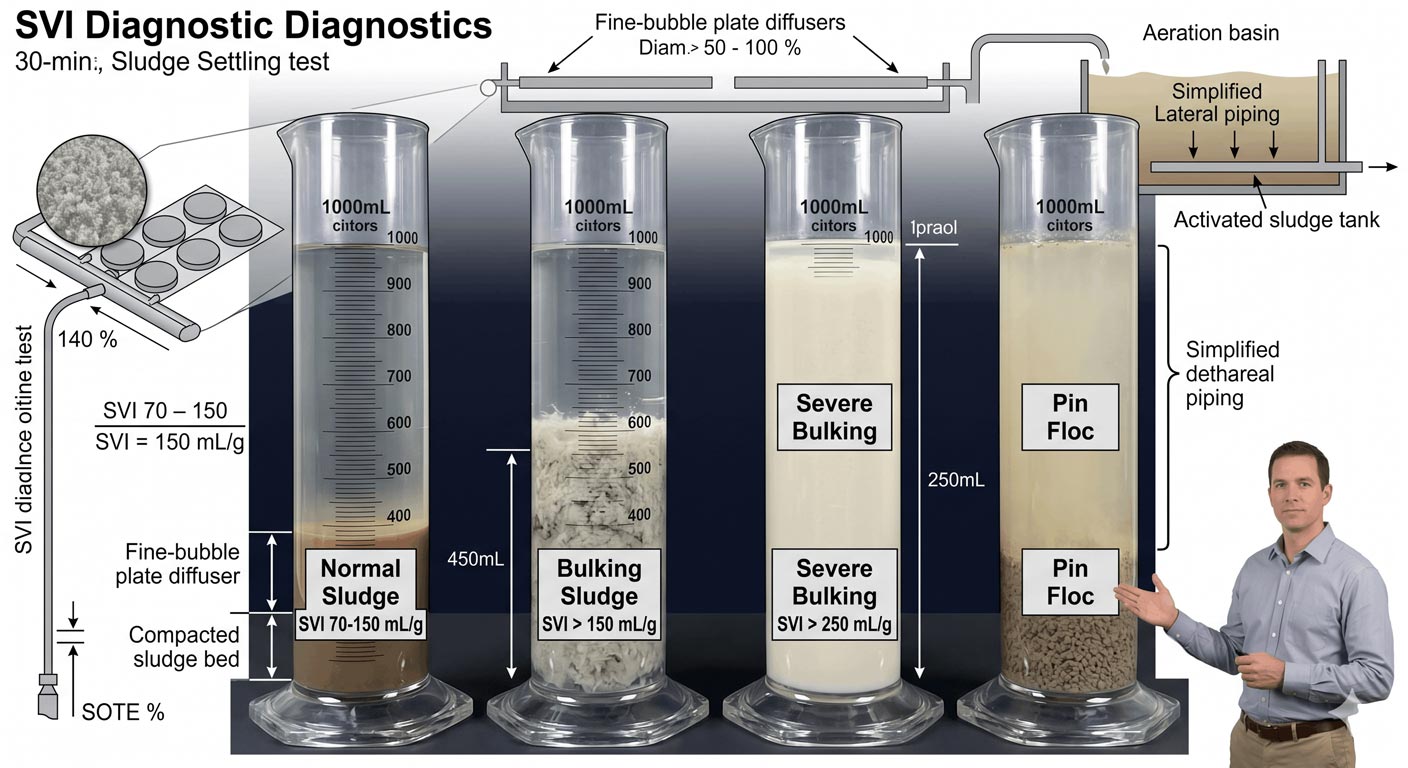
A high SVI means each gram of sludge occupies more volume — the sludge is fluffy, light, and hard to separate. The result: secondary clarifier performance collapses, effluent TSS rises, and biological treatment efficiency drops.
Filamentous bacteria are a normal part of healthy activated sludge — they form the structural backbone of floc particles. The problem begins when they overgrow and dominate the microbial community.
Filamentous organisms have a much higher surface-area-to-volume ratio than floc-forming bacteria. Under stress conditions — low DO, low substrate, low nutrients — this ratio gives them a competitive advantage: they can scavenge dissolved oxygen and substrate more efficiently than floc-formers. Once they proliferate beyond the threshold, they extend outward from the floc matrix, physically blocking sludge from compacting.
There are two structural patterns:
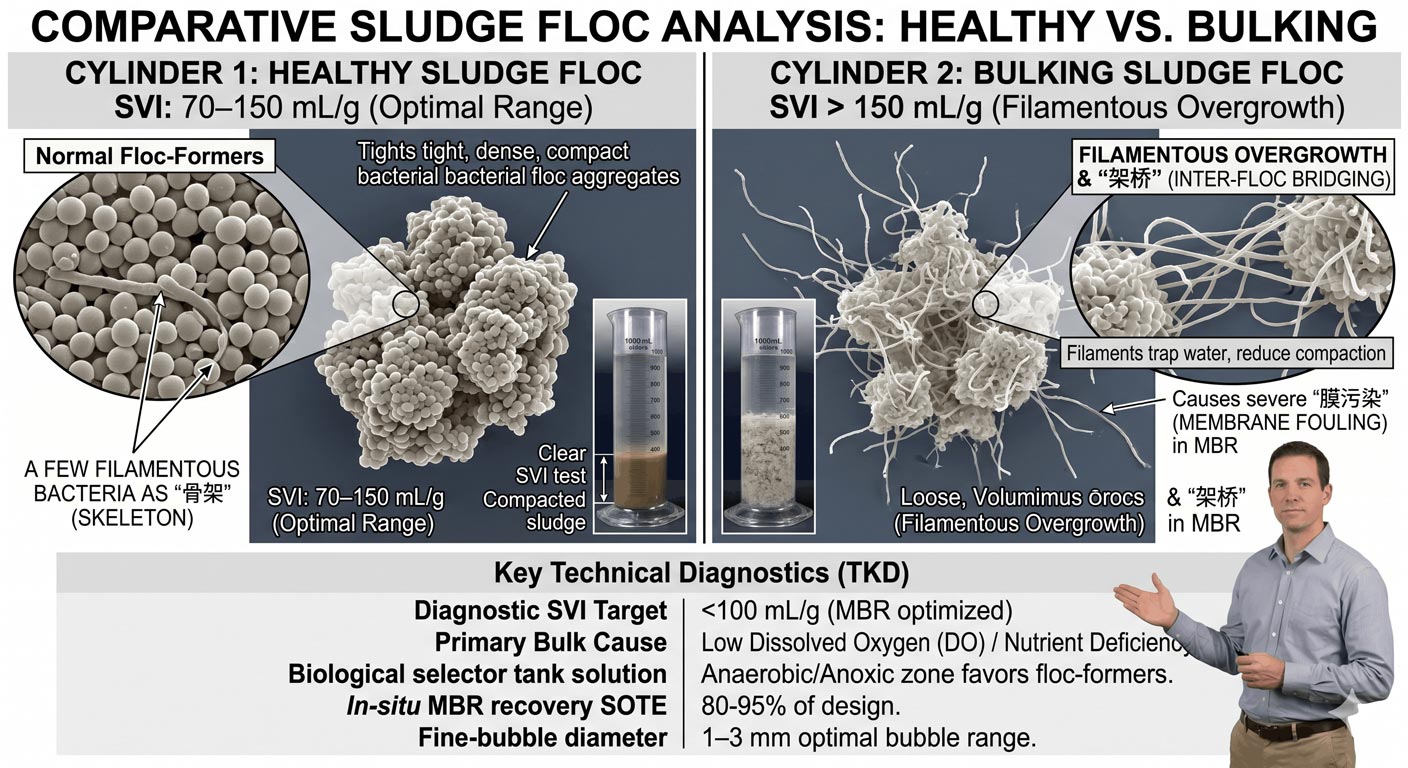
The most commonly identified filamentous organisms in WWTPs:
| Organism | Favored Condition | Common Process |
|---|---|---|
| Microthrix parvicella | Low temp, low F/M, lipids/fats | Municipal AS, A2O, oxidation ditch |
| Type 021N | Low DO, sulfide, low F/M | Industrial and municipal AS |
| Thiothrix spp. | High sulfide, septic influent | Municipal, food & beverage |
| Nocardia spp. | High lipids/surfactants, long SRT | Municipal, dairy, meat processing |
| Haliscomenobacter hydrossis | Low DO, low nutrients | Municipal, paper mill |
| Eikelboom Type 0041 | Low F/M, long SRT | Extended aeration systems |
| Beggiatoa spp. | High sulfide, anaerobic zones | Industrial, high-sulfate wastewater |
Filamentous bulking caused by Microthrix parvicella is strongly associated with low-temperature, low-loading conditions — it is a common winter phenomenon in municipal plants running A2O or oxidation ditch configurations. In one full-scale study at a Chinese A2O plant, SVI peaked at 265 ± 55 mL/g during winter months when sludge loading fell below 0.05 kg COD/(kg MLSS·day).
Non-filamentous bulking occurs when floc-forming bacteria themselves malfunction — not because filaments take over, but because the bacteria inside the floc produce abnormal quantities of extracellular polymer substances (EPS) that make the floc gelatinous and water-retaining.
Two sub-types:
Viscous (slime) bulking — bacteria produce excessive polysaccharide slime under nutrient deficiency (especially nitrogen or phosphorus deficiency). The sludge appears translucent and gel-like under microscopy. SVI is high, but filament counts are normal. The anthrone test (measures sludge polysaccharides) will show elevated values (>20%), which distinguishes this from zoogloeal bulking.
Zoogloeal bulking — Zoogloea bacteria overgrow under high F/M conditions or when specific organic acids and alcohols dominate the influent (from septic or fermented wastewater). The sludge forms finger-like or amoeba-shaped masses under the microscope. Unlike filamentous bulking, zoogloeal bulking is associated with high, not low, substrate concentrations.
Understanding the trigger is essential — treating the symptom (dosing chlorine) without fixing the root cause produces only temporary relief.
The most common operational cause. When DO falls below 1.0–1.5 mg/L in the aeration basin, filamentous bacteria — with their higher surface area — outcompete floc-formers for the limited oxygen available.
Target DO for stable activated sludge: 2.0 mg/L minimum, 2.0–3.0 mg/L sustained.
Low DO bulking organisms: Type 021N, Haliscomenobacter hydrossis, Sphaerotilus natans.
| DO Level | Risk |
|---|---|
| > 2.0 mg/L | Low risk |
| 1.0–2.0 mg/L | Elevated risk — monitor SVI weekly |
| < 1.0 mg/L | High risk — filamentous overgrowth likely within days |
| < 0.5 mg/L | Severe — bulking plus denitrification in clarifier (rising sludge) |
The most prevalent root cause of filamentous bulking overall. F/M (Food-to-Microorganism ratio) is the mass of BOD fed to the system per unit mass of MLSS per day.
F/M = BOD load (kg/day) / MLSS in aeration tank (kg)
At low F/M, substrate is scarce. Filamentous bacteria, with higher surface-area-to-volume ratio, are better equipped to scavenge the limited substrate than floc-forming bacteria. They dominate.
| F/M Range | Typical System | Bulking Risk |
|---|---|---|
| 0.05–0.10 kg BOD/kg MLSS/day | Extended aeration, oxidation ditch | Very high |
| 0.10–0.20 kg BOD/kg MLSS/day | Conventional AS, long SRT | Moderate |
| 0.20–0.40 kg BOD/kg MLSS/day | Conventional AS, normal SRT | Low |
| > 0.40 kg BOD/kg MLSS/day | High-rate AS | Low (but zoogloea risk at extremes) |
The practical fix is to increase F/M by wasting more sludge (increasing WAS rate) to reduce MLSS, or to accept a higher organic loading. Extended aeration plants are structurally at risk because they are designed to run at low F/M.
Activated sludge bacteria require nitrogen and phosphorus to build cell mass. The general minimum ratio is:
BOD : N : P = 100 : 5 : 1
When the influent BOD/N ratio exceeds 100:4, nitrogen becomes limiting. Bacteria respond by producing excess EPS from the undegraded carbon — the BOD that cannot be assimilated into cell growth gets stored as extracellular polysaccharide. This directly causes viscous (non-filamentous) bulking.
In industrial wastewater treatment — food processing, brewing, chemical plants — nutrient-deficient influent is extremely common because the wastewater is high in carbon but may contain minimal nitrogen or phosphorus.
Fix: Add external nitrogen (ammonium sulfate, urea) and phosphorus (phosphoric acid) to achieve the minimum BOD:N:P ratio.
When wastewater sits in collection pipes or holding tanks for extended periods without aeration, anaerobic conditions develop and sulfide (H₂S) builds up. Sulfide-favoring filaments — Thiothrix, Beggiatoa, Type 021N — proliferate when this sulfide-laden influent enters the aeration tank.
In one long-term full-scale study, Thiothrix bulking caused recurring sludge washout at a dairy WWTP. Thiothrix abundance reached 51.9% of total microbial community. Standard controls (polyaluminium chloride addition, VFA reduction) were ineffective. Only implementing periodic sludge starvation cycles reduced Thiothrix from 51.9% to 1.0% and restored stable settling.
Fix: Pre-aerate the influent before it enters the aeration basin, or dose iron salts in the collection system to precipitate sulfide.
A sudden increase in BOD, flow rate, or toxic inhibitor can temporarily disrupt the balance between floc-formers and filaments. The floc-forming bacteria, which are more sensitive to environmental changes, are selectively inhibited. Filamentous bacteria, with greater environmental tolerance, survive and grow into the gap.
This is particularly common in industrial plants receiving batch discharges, or municipal plants receiving storm water inflows.
Low temperature slows the metabolism of floc-forming bacteria more than filamentous bacteria. Microthrix parvicella is specifically cold-adapted and proliferates below 15°C. Municipal plants in temperate climates frequently experience filamentous bulking episodes in winter that self-resolve as temperatures rise in spring.
Conversely, very high temperatures (>35°C) can favor certain thermophilic filaments and disrupt normal floc structure.
Before treating bulking, identify which type and which cause. Treating the wrong cause wastes time and chemicals.
SVI > 150 mL/g confirms a settling problem. SVI > 250 mg/L is a severe bulking event.
Take a fresh mixed liquor sample and examine under a phase-contrast microscope at 100–400x magnification.
| What You See | Diagnosis |
|---|---|
| Long filaments extending between and outside floc particles | Filamentous bulking |
| Normal floc structure, but gelatinous/translucent appearance | Viscous (non-filamentous) bulking |
| Finger-like or amoeba-shaped masses | Zoogloeal bulking |
| Very small, dispersed micro-floc particles | Pin floc (low filament count, different problem) |
| Filaments confined inside floc, not extending outward | Normal — filaments beneficial at this level |
| Parameter | Normal Range | Bulking Trigger |
|---|---|---|
| DO in aeration basin | 2.0–3.0 mg/L | < 1.0 mg/L |
| F/M ratio | 0.15–0.35 kg BOD/kg MLSS/day | < 0.10 (filamentous) or > 0.5 (zoogloea) |
| SRT (Sludge Retention Time) | 8–15 days (conventional AS) | > 20 days (filamentous risk) |
| Influent BOD/N ratio | < 100:5 | > 100:3 (N deficiency) |
| Influent BOD/P ratio | < 100:1 | > 100:0.5 (P deficiency) |
| Effluent TSS | < 30 mg/L | > 50 mg/L (clarifier overflow) |
| Sludge blanket depth in clarifier | < 1.0 m | > 1.5 m (risk of overflow) |
The goal in the first week is to stop the clarifier from overflowing while you address root causes.
Increase return activated sludge (RAS) rate — pulling sludge back from the clarifier faster prevents the sludge blanket from rising to the effluent weir. Increase RAS to 75–100% of influent flow temporarily.
Reduce waste activated sludge (WAS) rate — counterintuitively, temporarily stopping or reducing WAS builds up MLSS, which increases the F/M ratio and disadvantages filamentous bacteria. Use with caution: if DO is already low, more MLSS makes the oxygen deficit worse.
Chlorination of RAS line — dosing chlorine (2–10 mg Cl₂/g MLSS/day) directly into the RAS pipe is the most widely used emergency control. Filamentous bacteria extending outside the floc are preferentially exposed to chlorine, while bacteria inside the floc are partially protected. This is a temporary fix — it does not address the root cause. Over-dosing destroys nitrifiers.
Coagulant addition — polyaluminium chloride (PAC) or ferric chloride dosed to the aeration basin or clarifier inlet improves short-term settleability for non-filamentous bulking. Less effective against filamentous types.
| Root Cause | Corrective Action |
|---|---|
| Low DO | Increase blower output, check diffuser fouling (DWP test), add aeration capacity |
| Low F/M | Increase WAS rate to reduce MLSS; or reduce SRT by 20–30% |
| N deficiency | Add ammonium sulfate or urea to achieve BOD:N ratio of 100:5 |
| P deficiency | Add phosphoric acid to achieve BOD:P ratio of 100:1 |
| Septic/sulfide influent | Pre-aerate influent; dose iron salts to sewer to precipitate H₂S |
| Temperature (winter Microthrix) | Increase sludge loading rate; reduce SRT; add selector |
| Shock loading | Install equalization basin; tighten industrial pretreatment controls |
A selector is a small contact zone (typically 5–10% of total aeration volume) placed before the main aeration basin, where influent wastewater meets return sludge under high substrate concentration.
Under high substrate (high F/M) conditions in the selector, floc-forming bacteria rapidly take up and store substrate as intracellular polymers. Filamentous bacteria, which are better adapted to low-substrate environments, cannot compete at high substrate concentrations and are selectively suppressed.
Three types of selectors:
| Selector Type | Mechanism | Best For |
|---|---|---|
| Aerobic selector | High F/M + DO > 2 mg/L | General filamentous bulking |
| Anoxic selector | High F/M + NO₃ as electron acceptor | Low DO filaments; also achieves denitrification |
| Anaerobic selector | High F/M, no O₂ or NO₃ | Suppresses aerobic filaments; watch for sulfide-forming types |
Selectors are the most reliable long-term structural fix for plants with chronic filamentous bulking, particularly low-F/M systems like extended aeration and oxidation ditches.
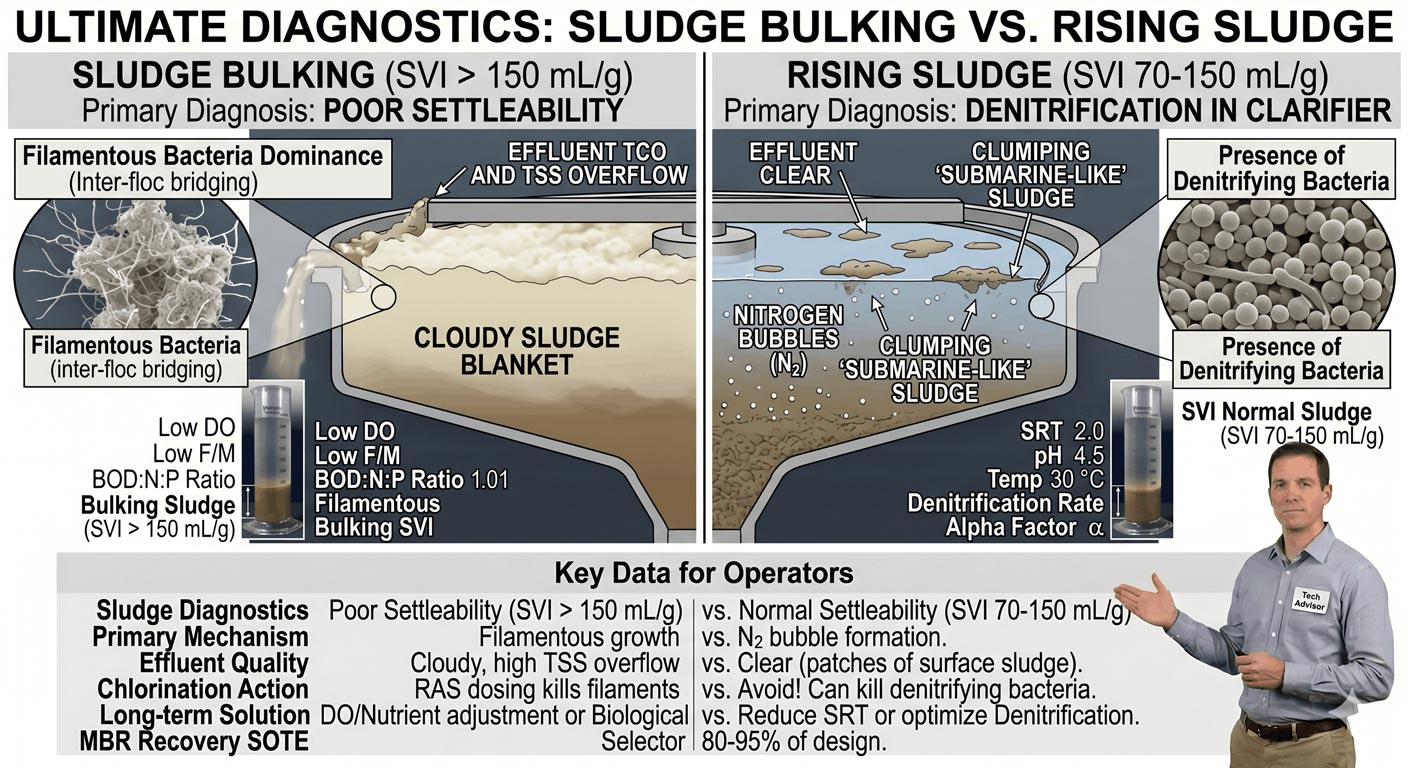
A common misdiagnosis. Both conditions cause solids in the effluent, but the causes and fixes are completely different.
| Sludge Bulking | Rising Sludge | |
|---|---|---|
| Mechanism | Poor settling — sludge won’t go down | Sludge settles, then rises due to gas |
| SVI | High (>150 mL/g) | Normal (80–150 mL/g) |
| Gas bubbles in clarifier | No | Yes — nitrogen or methane |
| Sludge appearance | Fluffy, light, voluminous | Normal floc structure |
| Main cause | Filamentous bacteria, low DO, low F/M | Denitrification in clarifier (NO₃ + insufficient DO) |
| Immediate fix | Increase RAS, dose chlorine | Increase clarifier DO or RAS rate; reduce NO₃ |
Rising sludge is caused by denitrification occurring inside the clarifier — NO₃ is converted to N₂ gas, which attaches to sludge flocs and lifts them to the surface. It looks identical to bulking from the effluent weir but requires opposite treatment logic.
When SVI exceeds 150 mL/g, run through this list in order:
Related products: Nihao’s disc diffusers and aeration hose maintain stable fine-bubble aeration and prevent the low-DO conditions that trigger filamentous bulking. MBBR media offers an alternative biological process that is structurally immune to sludge bulking — biofilm carriers are not subject to settling failure. Contact nihaowater for aeration system design support.



86-15267462807


86-15267462807
