English
 عربى
 Español
Cloudy effluent is one of the most common signs that a dissolved air flotation system is not operating as expected. However, poor DAF effluent quality does not automatically mean the machine is too small or that more chemicals are needed. Hydraulic overload, insufficient dissolved air, unstable flocculation, incorrect recycle flow, FOG emulsification, or poor sludge removal can all produce similar symptoms. The fastest way to solve the problem is to diagnose the process in the correct order.
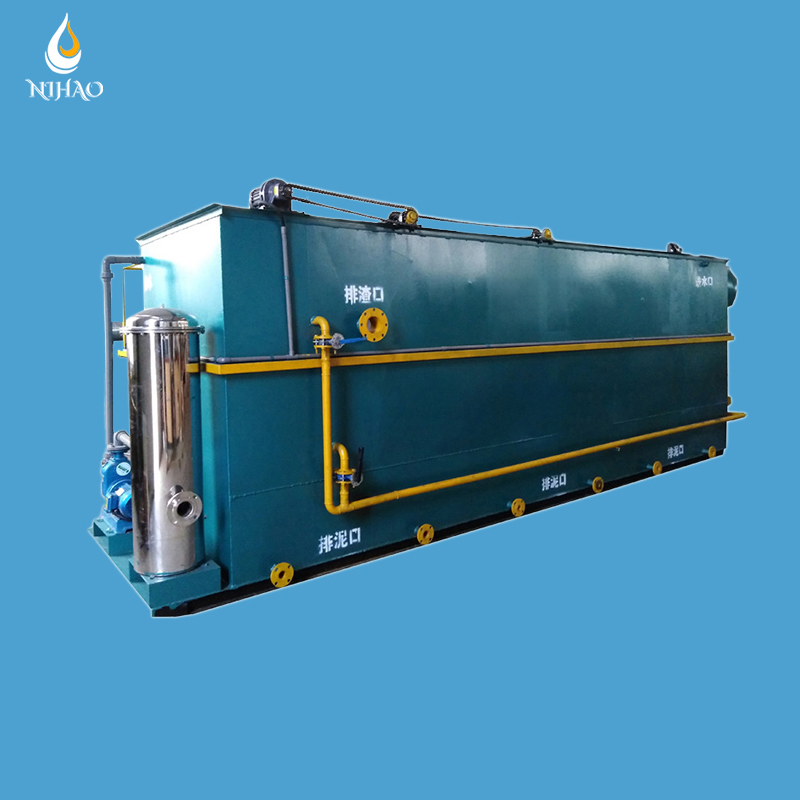
Cloudy DAF Effluent Does Not Always Mean the DAF Is Too Small
When suspended solids appear in the treated water, operators often make one of two immediate assumptions: the DAF is overloaded, or the chemical dose is too low.
Both can be true, but they are only part of the possible causes. Cloudy effluent is a symptom, not a diagnosis.
The visual appearance of the effluent can provide useful clues. Fine haze, visible floc, oily sheen, weak surface sludge, or sudden turbidity spikes often point toward different parts of the process.
| Observed Symptom | First Things to Check |
|---|---|
| Fine suspended haze | Coagulation, pH and flocculation quality |
| Visible floc in effluent | Hydraulic overload, floc breakup or short-circuiting |
| Oily sheen | FOG emulsification, chemical conditioning and bubble attachment |
| Sudden turbidity increase | Peak flow, influent shock or chemical change |
| Weak floating sludge layer | Dissolved air, recycle flow and air-to-solids ratio |
| Good float but dirty effluent | Scraper, sludge withdrawal or flotation-zone disturbance |
Changing chemical dose, recycle flow, or pressure without identifying the real cause can make the process less stable and increase operating cost.
Check Hydraulic Loading Before Adjusting Chemicals
Hydraulic overload is one of the first conditions to check because no amount of additional polymer can fully compensate for water passing through the flotation zone too quickly.
If the influent flow rises while the effective flotation area remains unchanged, the hydraulic loading rate increases:
Higher hydraulic loading reduces the time available for bubble attachment, floc rise, and separation between the floated sludge layer and the clarified water.
Operators should compare current conditions with the original design basis:
- current influent flow;
- peak hourly flow;
- average operating flow;
- recycle flow;
- effective flotation area;
- available equalization capacity.
If the effluent becomes cloudy mainly during production peaks, washdown periods, or batch discharge, hydraulic loading should be checked before increasing chemical dose.
An equalization tank can often reduce these peaks and stabilize both hydraulic loading and chemical treatment.
Is the DAF Producing Enough Fine Bubbles?
DAF depends on fine air bubbles attaching to floc and suspended contaminants. If bubble production becomes weak or uneven, flotation efficiency can drop quickly even if the tank itself is correctly sized.
Check the following:
Large Bubbles
Large bubbles rise too quickly and provide less effective attachment area for fine floc. They may indicate poor pressure release, inadequate saturation, or a problem with the release device.
Too Few Bubbles
Weak bubble density usually points toward insufficient dissolved-air production, inadequate recycle flow, low pressure, or air-saturation problems.
Uneven Bubble Distribution
If one area of the flotation zone appears milky with bubbles while another remains relatively clear, the release system may not be distributing air-water mixture evenly.
Fine, well-distributed bubbles provide more opportunities for attachment than a small number of coarse bubbles.
Air-to-Solids Ratio May Be Too Low
Even when hydraulic flow remains unchanged, the DAF can become overloaded if the solids load increases.
For example, a plant may continue operating at 25 m³/h while influent TSS rises from 800 mg/L to 1,500 mg/L.
The solids mass entering the system increases significantly:
25 × 800 ÷ 1000 = 20 kg TSS/h
25 × 1,500 ÷ 1000 = 37.5 kg TSS/h
If recycle flow and dissolved-air production remain unchanged, the amount of available air per kilogram of solids decreases.
This is why a DAF can become air-limited even when the wastewater flow has not changed.
Poor Coagulation Can Make Fine Particles Impossible to Float
Many suspended particles are too small or too electrically stable to attach effectively to air bubbles without chemical conditioning.
Coagulation destabilizes these particles so they can begin forming larger aggregates.
Important variables include:
- coagulant type;
- coagulant dose;
- wastewater pH;
- alkalinity;
- rapid-mix intensity;
- changes in influent composition.
If coagulation is weak, the effluent may appear cloudy even though the DAF produces plenty of bubbles.
Under-Dosing
Too little coagulant may leave fine colloids stable and difficult to capture.
Over-Dosing
Excessive coagulant is not automatically better. It can increase sludge production, chemical cost, and in some conditions reduce treatment stability.
If influent chemistry has changed, the correct solution may be pH adjustment or a different coagulation condition rather than simply increasing dosage.
Flocculation Problems: Too Small, Too Large or Too Fragile
After coagulation, flocculation should create particles large enough for reliable bubble attachment but strong enough to survive transport into the flotation zone.
Small particles remain suspended and produce hazy or cloudy effluent.
Good bubble attachment and stable flotation.
Large weak floc may break apart under pumps, valves or excessive mixing.
Operators should review:
- polymer type and dose;
- polymer preparation quality;
- polymer aging time;
- flocculator speed;
- mixing intensity;
- flocculation retention time;
- shear at the DAF inlet.
A common problem is that acceptable floc is formed upstream but is destroyed before entering the flotation zone.
Recycle Ratio Can Be Too Low—or Too High
Pressurized recycle is used to generate the dissolved-air stream that creates microbubbles. However, increasing recycle flow does not always improve treatment.
Recycle Too Low
- Insufficient dissolved air
- Weak bubble generation
- Poor solids lift
- More solids carryover
Recycle Too High
- Higher internal hydraulic load
- Greater pump energy
- More turbulence
- Potential floc breakup
The objective is not to maximize recycle flow. It is to provide enough dissolved air for the current solids load without destabilizing the flotation zone.
First confirm whether the system is air-limited, hydraulically overloaded, or suffering from chemical and flocculation problems.
Check the Sludge Layer and Surface Scraper
Sometimes flotation is working correctly, but solids are not being removed from the water surface efficiently.
A stable DAF should form a floating sludge layer that is continuously or periodically removed before excessive accumulation begins.
Common problems include:
- scraper speed too low;
- scraper speed too high;
- surface sludge layer too thick;
- sludge hopper blockage;
- sludge withdrawal pump problems;
- sticky FOG-rich sludge accumulating near the discharge point.
Scraper Too Slow
Excess sludge remains on the surface and may become unstable, sink, or re-enter the clarified water.
Scraper Too Fast
Excessive scraper movement can disturb the flotation blanket and push solids back into the water.
If bubble generation looks good and a strong sludge blanket is clearly forming, but effluent quality remains poor, inspect sludge removal before adjusting air or chemicals.
FOG-Rich Wastewater Needs Different Troubleshooting
Food, dairy, meat-processing, slaughterhouse, and edible-oil wastewater often contains high concentrations of fats, oils, and grease.
DAF is generally well suited to these contaminants because many FOG particles are naturally buoyant. However, emulsification can make them much more difficult to remove.
Free Oil vs Emulsified Oil
Free or weakly dispersed oil is relatively easy to separate. Chemically emulsified oil is stabilized in very small droplets and can pass through the DAF unless the emulsion is broken first.
Emulsification can increase when wastewater contains:
- CIP detergents;
- surfactants;
- cleaning chemicals;
- high-shear pumps or mixers;
- temperature changes.
If oily effluent suddenly appears after changes in cleaning procedures, chemical usage should be reviewed before assuming the DAF equipment has failed.
Changes in factory cleaning chemistry can therefore affect DAF performance even when flow and equipment settings remain unchanged.
Use a Step-by-Step Troubleshooting Order
The fastest diagnosis comes from checking the process in a fixed sequence rather than changing several operating parameters at once.
Check Flow
Confirm average flow, peak flow and whether equalization is functioning as intended.
Check Influent Quality
Compare current TSS, FOG, COD and pH with the original design basis.
Check Bubble Generation
Inspect saturator pressure, recycle flow, air supply, release devices and bubble quality.
Check Coagulation
Review coagulant dose, pH, mixing and recent changes in wastewater chemistry.
Check Flocculation
Observe floc size and strength, polymer preparation and whether floc is breaking before flotation.
Check the Flotation Zone
Look for excessive turbulence, short-circuiting, uneven bubble distribution and unstable float.
Check Sludge Removal
Inspect scraper speed, sludge thickness, hopper condition and withdrawal frequency.
When Cloudy Effluent Means the DAF Really Is Undersized
Equipment capacity should be questioned only after major operating problems have been ruled out.
A DAF may genuinely be undersized when:
- actual flow consistently exceeds the original design flow;
- solids loading is permanently much higher than the original design basis;
- air generation and recycle performance are normal;
- coagulation and flocculation are optimized;
- surface sludge removal is working correctly;
- effluent solids carryover still occurs under stable operation.
Possible solutions then include:
- adding equalization capacity;
- increasing effective flotation area;
- upgrading recycle and saturation capacity;
- installing a parallel DAF unit;
- reducing upstream solids load;
- improving pretreatment before the DAF.
DAF Effluent Still Cloudy?
NIHAO can help review DAF performance based on actual hydraulic and operating conditions. For an initial troubleshooting review, send your average and peak flow, influent TSS and FOG, pH, coagulant and polymer dose, recycle flow, saturator pressure, and photos or videos of the bubble zone and surface sludge.
By comparing hydraulic loading, air supply, floc condition, recycle performance, and sludge removal, the real cause can often be identified before major equipment changes are considered.
Frequently Asked Questions
Why is my DAF effluent cloudy?
Common causes include hydraulic overload, insufficient dissolved air, poor coagulation, weak or broken floc, incorrect recycle flow, FOG emulsification, or ineffective sludge removal.
Can low recycle flow cause poor DAF effluent quality?
Yes. If recycle flow is too low, the system may generate insufficient dissolved air and microbubbles for the current solids load.
How do I know if my DAF has enough dissolved air?
Check recycle flow, saturator pressure, air supply, bubble density, bubble size, and whether the flotation zone shows a fine and relatively uniform bubble distribution.
Can too much polymer cause cloudy DAF effluent?
Yes. Excessive polymer can create abnormal floc, increase sludge production, or destabilize treatment. Polymer dose should be optimized rather than simply increased whenever effluent quality declines.
Why does DAF performance get worse during peak production hours?
Peak production can increase hydraulic flow, TSS, FOG, or all three at the same time. This raises both surface loading and solids loading and may exceed the operating margin of the DAF.
Why are my DAF bubbles too large?
Large bubbles may be associated with poor saturation, incorrect pressure release, release-device problems, or inadequate air-water mixing. Coarse bubbles generally provide less effective attachment to fine floc.
Can excessive recycle flow reduce DAF performance?
Yes. Excess recycle increases internal hydraulic load and may create unnecessary turbulence or floc breakup even though it produces more dissolved-air flow.
Why does floated sludge fall back into the water?
Possible causes include excessive sludge accumulation, incorrect scraper speed, poor sludge withdrawal, unstable floc, or excessive turbulence in the flotation zone.
Why is emulsified oil difficult to remove with DAF?
Strong emulsions contain very small stabilized oil droplets that do not separate easily. Surfactants and cleaning chemicals can make the emulsion stronger, so chemical conditioning may be needed before flotation.
How do I know whether my DAF is actually undersized?
Suspect true capacity limitation only after confirming that flow, dissolved-air production, chemical conditioning, flocculation, recycle operation, and sludge removal are all functioning correctly. Persistent overload under these conditions may indicate insufficient flotation capacity.