English
 عربى
عربى
 Español
In a properly operating moving bed biofilm reactor, MBBR carriers should circulate through most of the reactor volume rather than forming a permanent floating layer, settling on the floor, or collecting in one corner. When carrier movement becomes uneven, the problem is rarely caused by one factor alone. Media density, biofilm growth, trapped gas, aeration, mixer performance, filling ratio, reactor geometry, retention screens, and wastewater chemistry can all change how carriers move.
How MBBR Media Is Supposed to Move in a Healthy Reactor
MBBR media is designed to move continuously through the biological reactor so that attached biofilm repeatedly contacts wastewater, dissolved oxygen, nutrients, and substrate. In aerobic reactors, this movement is usually created mainly by aeration. In anoxic or equalization zones, mechanical mixing may be required instead.
Healthy movement does not mean that every carrier must remain in exactly the same hydraulic condition at all times. Some temporary accumulation near walls or surfaces is normal. What matters is whether the bulk of the media continues to circulate and whether large permanent zones of floating, settling, or stagnant carriers develop.
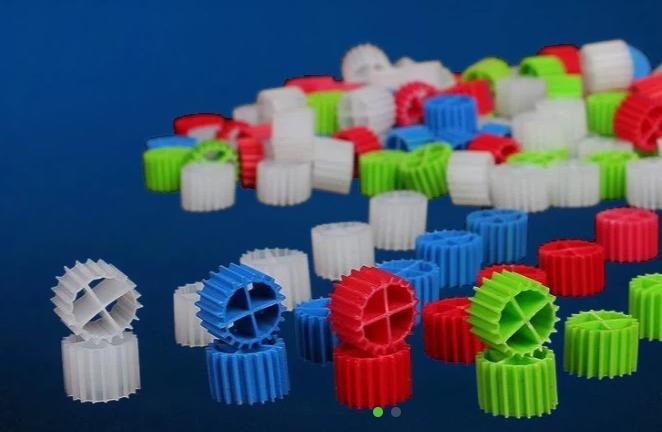
Carriers remain near the water surface and do not recirculate effectively.
Carriers move through most of the reactor volume with available mixing energy.
Carriers settle or remain in low-velocity zones near the tank floor.
Carrier density is important because MBBR media is normally designed to remain close to the density of water. However, the density of a clean plastic carrier is only the starting point. Once the reactor is operating, the effective carrier becomes a combination of plastic + biofilm + retained water + attached solids + gas bubbles.
A media sample that behaves correctly in clean water may move differently after several weeks of biofilm growth, solids accumulation, scaling, or changes in aeration.
Why MBBR Media Floats at the Surface
Persistent floating is often the first abnormal movement noticed by operators. A thin temporary surface layer is not always a serious problem, but a large floating mat can reduce effective contact between the biofilm and the wastewater and may interfere with screens, channels, or mechanical equipment.
1. The Finished Carrier Density Is Too Low
If the finished media is substantially lighter than the reactor liquid, insufficient mixing can allow it to remain at the surface. Density differences can result from resin selection, manufacturing variation, excessive foaming, inappropriate fillers, or a carrier model that is unsuitable for the intended process.
This is one reason buyers should compare the finished carrier density, not only the nominal density of the HDPE resin used to manufacture it.
2. Air Is Trapped Inside New Carriers
New media may float strongly when it is first introduced into a tank. Air can remain inside internal chambers or surface features before the media becomes fully wetted.
In this case, floating may decrease after soaking and circulation. Operators should therefore avoid concluding immediately that a new batch of media is defective simply because it initially remains at the surface.
3. Biological Gas Increases Temporary Buoyancy
Mature biofilm can trap gas bubbles. In zones where denitrification occurs, nitrogen gas may be generated within or around the biofilm. Carbon dioxide and other gases may also attach temporarily to the carrier surface.
This can make mature carriers periodically more buoyant, particularly when reactor conditions change between aerobic and low-oxygen periods.
4. Foam, Oil and Grease Trap Carriers Near the Surface
Industrial wastewater containing surfactants, fats, oils, grease, or stable foam can create a surface layer that physically captures MBBR media. In these cases, the problem is not the carrier density alone. Pretreatment, foam control, or oil and grease removal may need attention.
| Observed Condition | Likely Cause | What to Check |
|---|---|---|
| New media floats immediately | Trapped air or low finished density | Soaking behavior, carrier density, manufacturing consistency |
| Mature media floats periodically | Gas formation in or around biofilm | DO profile, denitrification conditions, biofilm thickness |
| Media trapped in foam | Surfactants, grease or foaming | Pretreatment and surface condition |
| Only one side of the tank floats | Hydraulic or aeration imbalance | Air distribution and circulation pattern |
Why MBBR Media Sinks or Accumulates on the Bottom
Bottom accumulation does not automatically mean that the plastic media itself is too heavy. In operating reactors, the more common causes are excessive biofilm, mineral deposition, solids accumulation, insufficient mixing, or an excessive filling ratio.
1. Excessive Biofilm Growth Increases Carrier Mass
Biofilm adds mass to each carrier. Under normal conditions, shear created by aeration and carrier collisions helps maintain a dynamic balance between biofilm growth and sloughing.
If organic loading is high and shear is too low, the biofilm may become unusually thick. The resulting carrier can become heavier and more difficult to suspend.
2. Inorganic Scaling Makes Media Heavier
Industrial wastewater can contain minerals that precipitate onto the carrier surface. Calcium carbonate, iron compounds, struvite, silica, or other deposits may increase carrier weight and gradually reduce internal open area.
This is especially important when sinking develops slowly over months rather than immediately after startup.
3. Suspended Solids Become Trapped Inside the Carrier
Some carrier geometries contain narrow internal channels or protected chambers. If the wastewater contains high suspended solids and hydraulic shear is insufficient, sludge and mineral solids may accumulate inside these structures.
The result can be both increased carrier weight and reduced effective biofilm area.
4. Mixing Energy Is Too Low
Even correctly manufactured media can settle if the reactor no longer provides enough mixing energy. Common causes include:
- reduced blower airflow;
- fouled or damaged diffusers;
- under-sized submersible mixers;
- poor mixer position;
- increased media filling ratio;
- changes in tank water level;
- uneven aeration across the reactor floor.
Before replacing carriers, check whether the reactor still provides enough hydraulic energy to move the actual media inventory under current biofilm and solids conditions.
Why MBBR Media Accumulates in Dead Zones
In many full-scale reactors, the most common carrier problem is not simple floating or sinking. Instead, media moves well through most of the tank but repeatedly accumulates in the same corner, near the wall, behind a baffle, or in front of an outlet screen.
This pattern usually indicates a hydraulic circulation problem.
Uneven Aeration Creates Strong and Weak Circulation Zones
Aeration does more than provide oxygen. Rising bubbles create bulk liquid circulation. If diffuser density or airflow is much higher in one part of the reactor, the strong circulation zone may push carriers into a weaker area where there is not enough energy to return them.
Incorrect Diffuser Layout Can Leave Corners Unmixed
A diffuser grid concentrated only in the center of a rectangular tank may generate good vertical circulation in the middle but weak movement near the edges. The result can be persistent media accumulation along walls or in corners.
Tank Geometry Can Create Recirculation Pockets
Long narrow tanks, irregular basins, support columns, internal walls, channels, and baffles can create low-velocity pockets. These areas may not be obvious during clean-water commissioning but can become more pronounced once the reactor contains a high volume of moving media.
Inlet Flow Can Push Media to One Side
A concentrated influent jet can dominate local circulation. If the inlet direction is poorly aligned with the main mixing pattern, carriers may repeatedly move toward one side of the tank.
Retention Screens Can Create Local Media Mats
Outlet retention screens prevent carriers from leaving the reactor, but the screen itself becomes part of the hydraulic system. Excessive face velocity, partial blockage, or insufficient screen area can draw large quantities of media against the screen.
Once a media mat forms, it may further increase local hydraulic resistance and make the accumulation worse.
| Media Pattern | Likely Problem | What to Inspect |
|---|---|---|
| One corner packed with media | Local dead zone | Tank geometry, diffuser coverage, mixer position |
| Media builds up near outlet screen | High screen velocity or blockage | Screen open area, fouling and hydraulic loading |
| Center moves but edges remain stagnant | Insufficient aeration coverage | Diffuser grid distribution |
| Bottom ring of carriers | Weak bottom circulation | Airflow, diffuser condition or mixer thrust |
| Surface layer only on one side | Asymmetric tank circulation | Inlet direction and aeration balance |
How Aeration and Mixing Control Media Movement
In an aerobic MBBR reactor, the aeration system usually has two simultaneous jobs: supplying oxygen and keeping the carriers moving.
These two requirements are related, but they are not identical.
Oxygen Transfer
Determines whether microorganisms receive enough oxygen for carbon removal, nitrification, and other aerobic reactions.
Hydraulic Mixing
Determines whether carriers circulate throughout the reactor and whether dead zones develop.
A reactor may show a dissolved oxygen concentration of 2–3 mg/L and still have poor carrier movement in part of the basin. This can happen when oxygen transfer is sufficient overall but airflow distribution does not create enough local circulation.
The reverse is also possible. Strong mixing may keep carriers moving while oxygen transfer remains insufficient for the biological load.
Signs That Media Movement Is Mixing-Limited
When these symptoms appear, operators should evaluate airflow, diffuser layout, diffuser condition, water depth, filling ratio, mixer thrust, and the overall circulation pattern rather than relying only on one DO measurement.
How Filling Ratio and Media Geometry Affect Circulation
Increasing the amount of media increases available biofilm surface area, but it also changes the hydraulic behavior of the reactor.
At a low filling ratio, individual carriers generally have more space to move and require less mixing energy. As the filling ratio increases, total carrier mass rises, collisions become more frequent, and the media bed creates greater resistance to liquid and air circulation.
This is why a reactor operating successfully at a 20% filling ratio cannot automatically be increased to 50% without checking aeration, mixing, screen capacity, and available free volume.
Media geometry matters as well. Carrier diameter, wall thickness, internal chambers, open area, protected surface area, and bulk packing characteristics all affect movement.
Extremely complex internal geometry may provide high theoretical surface area but can also increase solids trapping, reduce internal mass transfer, or make circulation more difficult under some wastewater conditions.
A practical carrier therefore needs a balance between biofilm area, hydraulic openness, mechanical durability, and ease of movement.
Biofilm Growth Changes Carrier Behavior During Startup and Operation
Media behavior can change substantially between the first day of startup and mature operation. This is one reason clean-water testing alone cannot fully predict long-term movement.
Clean Carrier
Plastic density dominates movement. Trapped air may cause temporary floating after installation.
Early Biofilm
Surface wettability improves and carrier mass increases as microorganisms begin to colonize the media.
Mature Biofilm
Biomass growth, gas formation, sloughing, and collisions create a more dynamic carrier condition.
Excessive Growth or Fouling
Thick biofilm, trapped solids or scaling may increase weight, clog internal spaces, and reduce movement.
Operators should therefore evaluate carrier circulation after the reactor reaches biological maturity. If movement progressively worsens as biofilm develops, the cause may be insufficient shear, excessive loading, poor sloughing, or inadequate mixing rather than the original carrier density.
Troubleshooting MBBR Media Movement Step by Step
The most efficient way to solve media movement problems is to diagnose them systematically. Replacing carriers before identifying the cause can waste money and leave the original hydraulic problem unresolved.
Observe the Movement Pattern
Determine whether the problem is whole-tank floating, whole-tank settling, one-corner accumulation, screen accumulation, or generally weak circulation.
Inspect the Media
Check carrier condition, finished density, biofilm thickness, scale, trapped solids, deformation, wear, and internal blockage.
Check Aeration
Review blower airflow, diffuser pressure drop, diffuser fouling, air distribution and DO at several locations rather than at one measurement point.
Check Hydraulic Mixing
Inspect inlet direction, tank geometry, baffles, submersible mixer position, weak circulation zones and bottom movement.
Confirm the Actual Filling Ratio
Compare the actual volume of installed media with the effective reactor volume, especially if more carriers were added after startup.
Inspect Retention Screens
Check blockage, open area, face velocity, damage, media mat formation and whether screen hydraulics are affecting reactor circulation.
Review Wastewater Chemistry
Look for high grease, surfactants, calcium, iron, suspended mineral solids, unusual salinity, foaming or biological gas formation.
When the Problem Requires Equipment Changes
Operational adjustments can solve many movement problems, but some reactors require physical modifications.
Poor Air Distribution
Modify the diffuser grid, rebalance airflow, clean diffusers or replace damaged units.
Weak Mechanical Mixing
Add, resize or reposition a submersible mixer to improve whole-tank circulation.
Unsuitable Media
Evaluate a carrier with more appropriate density, geometry or open structure.
Screen Accumulation
Increase retention-screen area or redesign the screen to reduce excessive local velocity.
Excessive Filling Ratio
Reduce carrier volume or increase available mixing capacity.
Mineral Scaling
Address wastewater chemistry or pretreatment rather than simply replacing the carriers.
Poor carrier movement can originate from the media itself, but it can also come from aeration, hydraulic design, screen loading, wastewater chemistry, or insufficient mixing.
MBBR Media Not Moving Properly?
If carriers are floating, settling, or collecting in one area of the reactor, the solution may involve media selection, aeration, mixer performance, retention-screen design, or filling ratio. NIHAO can help review the operating condition and identify which part of the system should be checked first.
For an initial review, provide the reactor dimensions, water depth, media model, installed media volume, filling ratio, blower airflow, diffuser type, mixer specifications, wastewater characteristics, and photos or videos showing carrier movement.
Frequently Asked Questions
Should MBBR media float or sink?
Proper MBBR media should generally remain close enough to neutral buoyancy that aeration or mechanical mixing can circulate it throughout the reactor. It should not form a permanent floating layer or remain settled on the tank floor.
Why does new MBBR media float when first added to water?
Air may be trapped inside carrier chambers before the media becomes completely wetted. This can cause temporary floating and may decrease after soaking and continuous circulation.
Why does MBBR media sink after several months of operation?
Possible causes include excessive biofilm growth, mineral scaling, trapped solids, inadequate mixing, reduced airflow, diffuser fouling or changes in wastewater characteristics.
Can excessive biofilm cause MBBR carriers to sink?
Yes. Thick biofilm adds mass to the carrier. If shear and mixing are insufficient to control biofilm thickness, mature carriers can become more difficult to suspend.
Why does MBBR media accumulate near the outlet screen?
Excessive screen face velocity, partial blockage, insufficient open area, or unfavorable reactor circulation can draw carriers toward the screen and create a persistent media mat.
Can low aeration cause MBBR media to stop moving?
Yes. In aerobic MBBR reactors, aeration usually provides both oxygen and mixing. Reduced airflow or fouled diffusers may leave some parts of the reactor without enough circulation.
Does a higher filling ratio require more mixing energy?
Usually yes. More carrier volume increases total media mass, collision frequency and hydraulic resistance. Aeration or mixer capacity should be checked before increasing the filling ratio.
How can I identify dead zones in an MBBR reactor?
Repeated media accumulation, bottom deposits, stagnant carriers, uneven DO, different biofilm appearance and weak circulation near corners or walls are common signs of dead zones.
Can inorganic scaling make MBBR media heavier?
Yes. Calcium carbonate, iron compounds, struvite and other mineral deposits can accumulate on the carrier and increase its mass while reducing internal open area.
When should poorly moving MBBR media be replaced?
Replacement should be considered when the carrier itself is damaged, heavily deformed, permanently clogged, excessively scaled or clearly unsuitable for the application. If the real cause is poor aeration, mixing or screen hydraulics, replacing the media alone may not solve the problem.